

Security & Blockchain Hacks
Energy safety is barely achievable via international partnerships


![[Security & Blockchain Hacks]](https://blocktrend.online/wp-content/uploads/2025/06/Energy-security-is-only-achievable-through-global-partnerships.jpg)
Energy safety is barely achievable via international partnerships
Discover the newest traits within the Altcoin house. This article dives into: “Energy security is only achievable through global partnerships”.
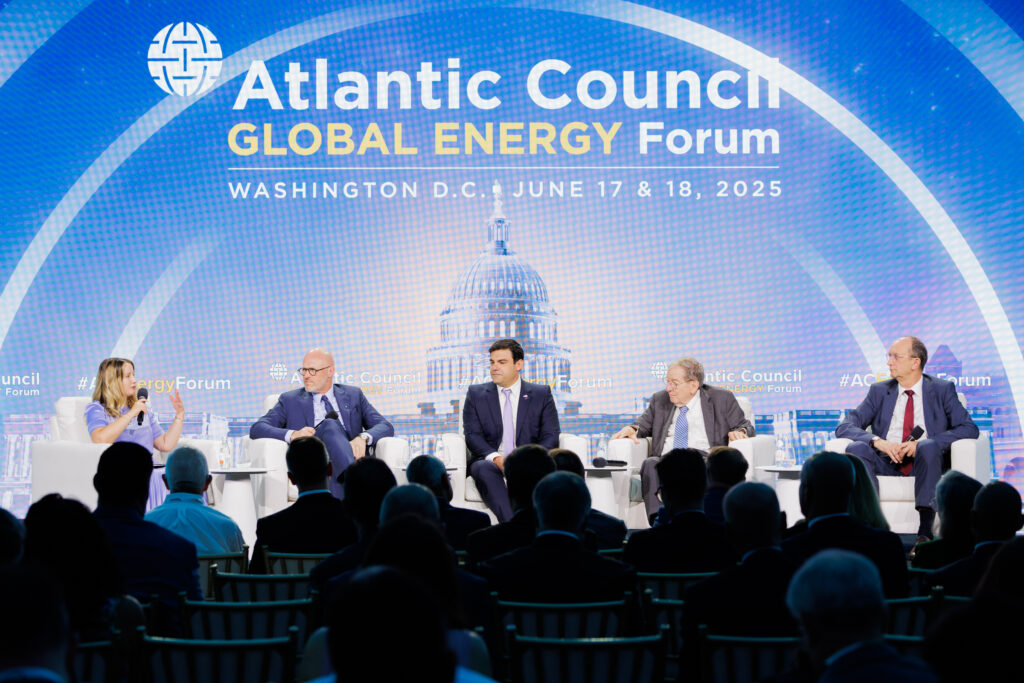
The Atlantic Council’s flagship Global Energy Forum concluded its programming in Washington, DC, at the moment. What emerged as a central theme all through was the plain want for any single nation to have interaction in worldwide partnerships to attain power and nationwide safety, whether or not audio system have been discussing divergent transatlantic views, nuclear energy, or essential mineral provide chains.
What transatlantic power cooperation seems to be like underneath America First
The panel “Partnership for prosperity: Can the US and Europe both win in the America First era?” addressed the evolving panorama of transatlantic relations, specializing in each the challenges and alternatives that lie forward. The dialogue was moderated by Olga Khakova, deputy director for European power safety on the Global Energy Center (GEC), panelists included Amb. Richard Morningstar, founding chairman of the GEC and former US ambassador to the European Union (EU), Torgrim Reitan, chief monetary officer of Equinor, Toby Rice, president and chief govt officer (CEO) of EQT, and Klaus Wiener, member of the German Bundestag.
A central theme all through the dialog was the enduring connection and shared values between the EU and the United States, grounded in a long-standing alliance. Wiener affirmed “we are very strong allies,” whereas Reitan added, “we belong together.” These feedback underscored the historic and strategic ties between the United States and Europe.
While acknowledging the connection’s present difficulties, all panelists agreed on the necessity to discover frequent floor and foster a forward-looking agenda rooted in mutual pursuits. The panelists raised liquefied pure gasoline (LNG) as a focus of transatlantic cooperation. “Europe needs security and flexibility and US LNG can provide for that,” mentioned Rice, highlighting LNG as a central problem in US-EU negotiations.
Morningstar emphasised that different power applied sciences, together with nuclear and fusion, also needs to be thought-about. He famous that the event and deployment of those applied sciences will rely not solely on political will but additionally on personal sector engagement. When requested in regards to the future, Reitan responded, “we need to build predictability and overcome barriers.”
Nuclear power has international momentum. What’s subsequent?
Jennifer T. Gordon, director of the GEC’s Nuclear Energy Policy Initiative, moderated “The role of nuclear energy in global energy security,” a dialogue that includes Sama Bilbao y León, director basic of the World Nuclear Association, Aleshia Duncan, deputy assistant secretary for worldwide cooperation on the US Department of Energy’s Office of Nuclear Energy, Amb. Georgette Mosbacher, co-chair for Three Seas programming on the Atlantic Council Europe Center and former US ambassador to Poland, Jeremy Pocklington CB, everlasting secretary on the United Kingdom’s Department of Energy Security and Net Zero, and Robert Rudich, chief enterprise improvement officer of Synthos Green Energy.
Gordon started by highlighting that the dialog takes place at an thrilling time for nuclear each globally and within the United States, the place 4 current nuclear power-focused govt orders show “an ambitious agenda for civil nuclear partnerships.” Duncan detailed US authorities efforts to make sure these partnerships succeed. Nuclear energy is “a 100-year relationship,” Duncan mentioned, noting the pitfalls inherent with such timescales.
Bilbao y León offered a world tour of the nuclear sector’s momentum, citing reversals of opposition to nuclear energy in European states and on the World Bank, an extended record of tasks underway throughout the Global South, and efforts to guide within the know-how by each the United States and China. Bilbao y León lauded the progress of a 31-nation “coalition of the ambitious,” which is mobilizing to understand the COP28 goal of tripling international nuclear capability by 2050.
Pocklington centered on the United Kingdom, which is constructing new standard and superior reactor capability along with prolonging and maximizing present nuclear energy technology. “The single greatest challenge,” he mentioned, “is figuring out what we can do to speed up the process,” citing monetary improvements that the nation is pioneering to make tasks a actuality.
The subsequent two panelists mentioned US nuclear partnerships in Poland and Central Europe. Mosbacher praised Poland’s foresight in decreasing its reliance on Russian gasoline even earlier than the full-scale invasion of Ukraine. Today, she argued, US policymakers should train comparable foresight in fostering partnerships to maintain tempo with nuclear-exporting adversaries in Russia and China: “if we don’t scale up fast, we will be left behind.” Rudich provided a personal sector perspective, elaborating on Polish agency Synthos Green Energy’s efforts with North American companions to construct superior reactors that can finally “go beyond Poland and construct the Green Wall.” This zone, stretching from the Baltic states to the Black Sea, would use nuclear energy to remove dependency on Russian power. Helping to enact this bold plan, Rudich argued, is profoundly within the US nationwide curiosity: “energy dominance,” he mentioned, “means exports.”
Gordon concluded the dialog by asking what members want to see modified in nuclear power earlier than the 2026 Global Energy Forum. As stakeholders more and more understand “energy security is national security,” Duncan recommended, “we should fund it as such.” Duncan and Bilbao y León each emphasised the significance of management for the deployment of reactors at scale. Rudich concluded by stressing the necessity for funding to translate into motion: “we need to start doing projects and move away from talking about doing projects.”
Can fast wins in essential minerals cut back reliance on China?
The closing panel of the Global Energy Forum, “Critical minerals, critical decisions: Quick wins in critical mineral supply chain partnerships,” was moderated by Audrey Hruby, Atlantic Council Africa Center senior advisor, and featured Helaina Matza, chief strategic improvement officer of TechMet, Stephen Rowland, head of North America copper at Glencore, Reggie Singh, director of the US Department of State Bureau of Energy Resources’ Critical Minerals and Energy Technology Office, and Imad Toumi, chairman and CEO of Managem.
Hruby started by elucidating the central purpose of the dialog: “in a long-term sector like mining, we want to look for quick wins.” The basic problem? “We rely too much on one major player for all our critical minerals: China,” continued Singh, who elaborated on how the US authorities is working to provoke worldwide partnerships that diversify provide whereas assembly quickly rising minerals demand.
Matza, delivering a monetary sector view of presidency initiatives, recommended bipartisan efforts to “operate a little more like US Government, Inc.,” and make use of distinctive capabilities amongst companions to convey extra provides to market. Toumi, who runs a Moroccan minerals firm, shared an African perspective: “we no longer want to export raw materials; we need to refine.” He offered an summary of his firm’s efforts to work with African companions to construct holistic provide chains capable of compete with China.
Rowland zeroed in a single key mineral—copper—which is confronted with spiking demand from electrification and knowledge facilities. Despite this problem, Rowland recommended useful resource availability isn’t the problem: “it’s hard to say if the bottleneck is copper or power,” declaring the insufficient scale of extraction.
Hruby concluded by posing a rapid-fire query to the panel: “what can we achieve in 24 months rather than five-to-ten years?” Participants responded with measures comparable to pushing ahead shovel-ready tasks, fostering innovation and recycling, and legislative modifications within the United States and globally to fast-track improvement.
Equinor and EQT are sponsors of the Atlantic Council’s Global Energy Forum. Managem is a sponsor of the Atlantic Council’s Africa Center. More data on Forum sponsors will be discovered right here.
Elena Benaim is a nonresident fellow with the Atlantic Council Global Energy Center.
Paddy Ryan is a former assistant director with the Atlantic Council Global Energy Center. He is a senior author/editor on the University of California Institute on Global Conflict and Cooperation.
MEET THE AUTHOR


RELATED CONTENT
OUR WORK

The Global Energy Center develops and promotes pragmatic and nonpartisan coverage options designed to advance international power safety, improve financial alternative, and speed up pathways to net-zero emissions.
Image: Panelists on a stage focus on US-EU power cooperation. (Atlantic Council)
Related Articles
Uncover sizzling subjects within the crypto finance house. This article breaks down: “Energy security is only achievable through global partnerships”.
- Blockchain & Crypto Trends — keep forward with international adoption, tech shifts & improvements
- DeFi & Web3 Innovations — discover the way forward for finance and web decentralization
- NFT, Gaming & Metaverse — dive into digital economies and digital asset revolutions
- AI & Blockchain Integration — uncover how AI enhances trustless blockchain ecosystems
- Regulations & Global Tech — observe legal guidelines, compliance, and international tech coverage impacts
- Tokenomics & Coin Analysis — decode venture worth, utility, and investor metrics
- Security & Blockchain Hacks — defend your crypto with risk and exploit insights
- Mining & Validator Ecosystem — find out about staking, block rewards, and consensus
Cross-Site Crypto Insights
- Explore BlockTrend for professional takes on blockchain traits & developments
- Visit CryptoCoil for stay market knowledge, altcoin insights & sentiment monitoring
- Check i-News for recent international crypto headlines & breaking tales
- Claim & earn with trusted drops on i-Coin — your faucet & incomes hub
- Learn crypto the good means on i-VIP — sensible tutorials, guides & suggestions for novices
- Discover curated crypto insights on SFBNEWS — automated crypto updates & professional curation
[ad_3]
Original Source
This article is customized from www.atlanticcouncil.org. We’ve restructured and rewritten the content material for a broader viewers with improved readability and search engine marketing formatting.
Continue Your Crypto Journey
Dive deeper on BLOCKTREND to remain forward in crypto.


![[Blockchain & Crypto Trends]](https://blocktrend.online/wp-content/uploads/2025/08/XRP-Emergency-Price-Break-Bitcoin-BTC-Losing-100000-If-This-400x240.jpg)

![[Blockchain & Crypto Trends]](https://blocktrend.online/wp-content/uploads/2025/08/XRP-Emergency-Price-Break-Bitcoin-BTC-Losing-100000-If-This-80x80.jpg)
![[Blockchain & Crypto Trends]](https://blocktrend.online/wp-content/uploads/2025/08/Trump-Media-Partners-With-Cryptocom-Launches-US1B-CRO-Strategy-Vehicle-400x240.jpg)
![[Blockchain & Crypto Trends]](https://blocktrend.online/wp-content/uploads/2025/08/Trump-Media-Partners-With-Cryptocom-Launches-US1B-CRO-Strategy-Vehicle-80x80.jpg)

![[Blockchain & Crypto Trends]](https://blocktrend.online/wp-content/uploads/2025/08/Bitcoin-miner-Hut-8-announces-15GW-expansion-in-the-US.jpg)

![[Blockchain & Crypto Trends]](https://blocktrend.online/wp-content/uploads/2025/08/REX-Financial-CEO-Solana-Not-Ethereum-Is-the-Future-of.webp-400x240.webp)
![[Blockchain & Crypto Trends]](https://blocktrend.online/wp-content/uploads/2025/08/REX-Financial-CEO-Solana-Not-Ethereum-Is-the-Future-of.webp-80x80.webp)

![[Blockchain & Crypto Trends]](https://blocktrend.online/wp-content/uploads/2025/08/CZ-Says-I-Advise-Twelve-Governments-and-Leaders-on-Crypto.png)

![[Security & Blockchain Hacks]](https://blocktrend.online/wp-content/uploads/2025/08/A-new-security-flaw-in-TheTruthSpy-phone-spyware-is-putting-400x240.jpg)
![[Security & Blockchain Hacks]](https://blocktrend.online/wp-content/uploads/2025/08/A-new-security-flaw-in-TheTruthSpy-phone-spyware-is-putting-80x80.jpg)
![[NFT, Gaming & Metaverses]](https://blocktrend.online/wp-content/uploads/2025/08/Ethereum-is-very-much-%E2%80%98the-Wall-Street-token-VanEck-CEO-400x240.jpeg)
![[NFT, Gaming & Metaverses]](https://blocktrend.online/wp-content/uploads/2025/08/Ethereum-is-very-much-%E2%80%98the-Wall-Street-token-VanEck-CEO-80x80.jpeg)

![[Security & Blockchain Hacks]](https://blocktrend.online/wp-content/uploads/2025/08/Criminals-are-%E2%80%98vibe-hacking-with-AI-at-unprecedented-levels-Anthropic.png)

![[AI & Blockchain Integration]](https://blocktrend.online/wp-content/uploads/2025/08/Nvidia-reports-record-sales-as-the-AI-boom-continues-400x240.jpg)
![[AI & Blockchain Integration]](https://blocktrend.online/wp-content/uploads/2025/08/Nvidia-reports-record-sales-as-the-AI-boom-continues-80x80.jpg)
![[DeFi & Web3 Innovations]](https://blocktrend.online/wp-content/uploads/2025/08/Alchemy-Pay-plugs-fiat-ramp-into-Boyaas-Web3-poker-game.w-400x240.webp)
![[DeFi & Web3 Innovations]](https://blocktrend.online/wp-content/uploads/2025/08/Alchemy-Pay-plugs-fiat-ramp-into-Boyaas-Web3-poker-game.w-80x80.webp)

![[Mining & Validator Ecosystem]](https://blocktrend.online/wp-content/uploads/2025/08/REX-Osprey-files-for-BNB-staking-ETF-as-monthly-inflows-pick.png)

![[Tokenomics & Coin Analysis]](https://blocktrend.online/wp-content/uploads/2025/08/Investors-Flock-To-XYZVerse-XYZ-For-Promising-Potential-While-ONDO-400x240.jpg)
![[Tokenomics & Coin Analysis]](https://blocktrend.online/wp-content/uploads/2025/08/Investors-Flock-To-XYZVerse-XYZ-For-Promising-Potential-While-ONDO-80x80.jpg)

![[Tokenomics & Coin Analysis]](https://blocktrend.online/wp-content/uploads/2025/08/Pi-Coins-Charts-Hint-at-a-Turnaround%E2%80%94Heres-Why-a-40.png)

![[Security & Blockchain Hacks]](https://blocktrend.online/wp-content/uploads/2025/08/Anthropic-Cybersecurity-Team-Warns-%E2%80%98Agentic-AI-Has-Been-Weaponized.png)

![[AI & Blockchain Integration]](https://blocktrend.online/wp-content/uploads/2025/08/Swarm-Network-raises-13M-to-facilitate-decentralized-AI-400x240.jpeg)
![[AI & Blockchain Integration]](https://blocktrend.online/wp-content/uploads/2025/08/Swarm-Network-raises-13M-to-facilitate-decentralized-AI-80x80.jpeg)