

Security & Blockchain Hacks
For the US and the free world, safety calls for a resilience-first strategy


![[Security & Blockchain Hacks]](https://blocktrend.online/wp-content/uploads/2025/07/For-the-US-and-the-free-world-security-demands-a.jpg)
For the US and the free world, safety calls for a resilience-first strategy
Explore key highlights within the DeFi area. This article dives into: “For the US and the free world, security demands a resilience-first approach”.
July 8, 2025 • 8:00 am ET
Print this web page
For the US and the free world, safety calls for a resilience-first strategy
This report is the foundational doc of the Adrienne Arsht National Security Resilience Initiative (AANSRI) and descriptions a daring imaginative and prescient to embed resilience as a core pillar of US and allied safety. As crises compound, the initiative requires investing throughout particular person, institutional, and worldwide ranges of resilience to face up to, adapt, and thrive amid disruption.
Acknowledgements
This report is made potential by the imaginative and prescient and generosity of Adrienne Arsht, whose dedication to resilience as a nationwide and world crucial has pushed the event of the AANSRI. Her curiosity to discover how people construct resilience—and why some folks stand up to adversity whereas others wrestle—has opened new avenues for understanding the position of resilience in shaping societies. This initiative extends that focus, recognizing that resilience isn’t solely a person trait however a collective necessity, underpinning neighborhood cohesion, nationwide safety, and worldwide stability.
The writer additionally extends her gratitude to the members of the AANSRI, whose unwavering dedication and beneficiant insights have been instrumental in growing this report over the previous 9 months. They are leaders and progressive thinkers of their respective fields, and their dedication and collaborative spirit have been invaluable in shaping the way forward for the initiative’s work. The writer additionally needs to thank former Atlantic Council employees member Danielle Miller for her efforts in organizing the duty drive from its inception.
Table of contents
Prologue: Resilience in motion
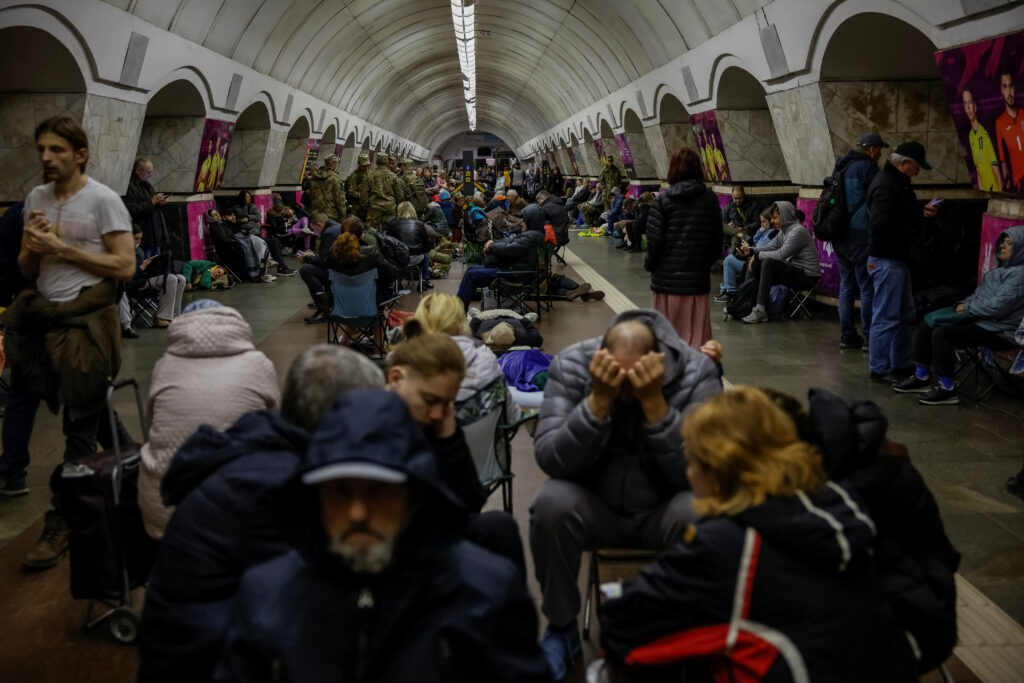
At daybreak on February 24, 2022, Kyiv woke to explosions. Sirens screamed throughout the Ukrainian capital. Families rushed into underground shelters. Russia’s full-scale invasion had begun. Although the intelligence neighborhood had sounded the alarm, for a lot of odd Ukrainians the sound of missiles placing their metropolis was nearly unimaginable. Just days earlier, life had felt regular for many of the nation: work, faculty, errands, birthdays. A full-scale struggle had arrived straight away and shattered the phantasm of security and safety.
In his condo, cybersecurity entrepreneur Yegor Aushev took a name from Ukraine’s Ministry of Defense. The official didn’t give him orders, solely a request: assist us defend the nation in our on-line world. Aushev issued a message urging fellow cybersecurity professionals, builders, and moral hackers to hitch Ukraine’s digital resistance. By dusk, hundreds had signed up, with Ukrainians and worldwide allies alike providing their credentials, their abilities, and their will to assist.
Telegram channels multiplied and volunteers on this “IT Army” started to efficiently disrupt Russian navy communications. This rapidly configured job drive additionally helped to defend Ukrainian techniques and mapped vulnerabilities throughout a sprawling and unstable digital battlefield. While tanks superior on Kyiv and battles unfolded across the nation, civilians launched a cyber counteroffensive.
At the identical time, neighbors throughout the capital self-organized. Apartment buildings pooled meals and medical college students ran first help coaching. Teachers organized on-line classes to withstand disruption to kids’s schooling. Volunteers repurposed apps into instruments for sharing alerts and data.
Kyiv’s municipal authorities tailored at tempo. Within seventy-two hours, the town’s public companies app (Kyiv Digital) was reprogrammed to offer real-time air-raid alerts, instructions to shelters, and updates on pharmacy provides. Local authorities coordinated gasoline deliveries and waste collection beneath bombardment. Officials rerouted energy and guarded infrastructure with the information that assist may not come for days.
Nationally, the federal government didn’t break. Thanks to pre-invasion choices, Ukraine’s essential digital infrastructure had already been migrated to safe cloud servers by partnerships with Amazon and Microsoft. Ministries continued to perform, the parliament tailored, and the cupboard met in bunkers. President Volodymyr Zelenskyy refused evacuation. Instead, he remained, showing on digicam night time after night time, anchoring each morale and state legitimacy. Many residents instantly stepped ahead to hitch the navy response, at nice private danger and infrequently with none prior coaching.
Outside the nation, the response accelerated. Following a pre-invasion declaration of help, the United Kingdom deployed anti-tank missiles, logistics help, and intelligence to help with Ukraine’s defenses. The United States shortly licensed help within the type of anti-aircraft techniques, small arms, and ammunition, in addition to essential intelligence help. Estonia offered cyber intelligence and experience, Polish nongovernmental organizations (NGOs) offered medical care and meals on the border, and California offered satellite tv for pc web. Drones got here from Turkey due to some prior planning, and refugee help got here from Germany, amongst different nations. Coordination was messy, however allies had been leaning in shortly.
Ukraine’s protection in these first weeks didn’t rely solely on weapons or partitions. It was held collectively by a residing system of resilience: the foresight of nationwide establishments, the agility of native authorities, the improvisation of communities, the solidarity of worldwide companions, and—most critically—the resolve of particular person residents and communities who stood up when nothing was sure.
When the missiles got here, Ukraine tailored and withstood, refusing to break down. The shock and chaos of struggle in our personal neighborhoods are inconceivable to most of us, however what if our communities get up to a disaster on a scale we now have by no means skilled? We have an important alternative to study classes from those that have proven us what resilience in motion actually means. They have proven us that resilience doesn’t start on the level of disaster. It begins in coverage choices made years earlier, in drills performed with out headlines, within the wiring of establishments, in civic belief, in practiced autonomy, and within the mindsets and resilience of odd folks. We all have roles to play.
Part 1: Understanding the resilience problem—and why it issues
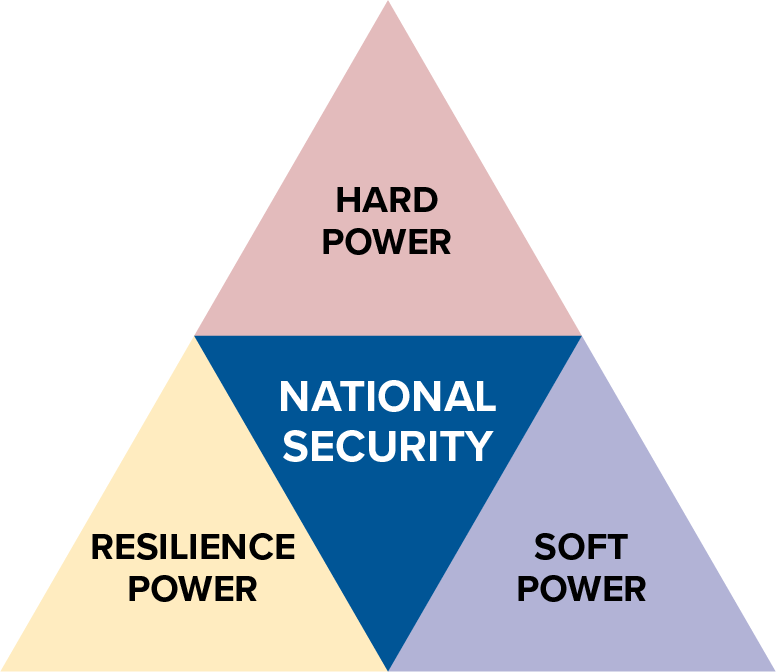
Resilience is a necessary—but typically publicly underappreciated—aspect of nationwide safety. Public discourse typically facilities on deterrence, diplomacy, navy energy, and intelligence capabilities. However, rising and protracted threats—from cyberattacks and local weather change to pandemics and acute pure hazards—have revealed important gaps in nationwide and worldwide resilience, pushing the subject a lot additional up the agenda. Resilience, or “resilience power,” is the muse on which “hard power” and “soft power” relaxation. Without these components, a nation is uncovered, and its broader safety technique weakened.
The 2017 US National Security Strategy incorporates six references to resilience, in contrast with thirty-six to protection. By the discharge of the 2022 US National Security Strategy, there have been twenty-nine references to resilience in contrast with thirty-one to protection, reflecting the rising significance of the subject. It’s clear that democracies are more and more seeing the necessity to anticipate, endure, and bounce ahead.
Despite the rising give attention to resilience in nationwide safety and coverage discussions, too little consideration has been paid to the components that allow people to develop and maintain resilience. Governments typically prioritize infrastructure hardening and institutional preparedness whereas neglecting the human aspect. Along with a top-down strategy, the United States should do extra to make sure that residents are psychologically, socially, and economically geared up to endure, and emerge nicely from crises. Without addressing these individual-level components, broader resilience and nationwide safety methods danger failing their most necessary accountability: to safeguard residents. The AANSRI will look to redress this stability, advocating for rising focus and a focus on this important space of resilience work.
National safety methods are precious alternatives to survey the danger panorama and chart a course for the long run. Yet in a world the place particular threats are troublesome to foretell, such methods can shortly really feel outdated or overtaken by occasions. A resilience-first strategy provides larger adaptability. Rather than focusing solely on defining threats and prescribing bespoke options, it equips nations, communities, and people to construct the capability to anticipate disruption, soak up shocks, and adapt to quickly altering circumstances. It calls for way more effort to shut the vulnerabilities that adversaries search to use. And it embraces uncertainty, enabling a extra dynamic and enduring type of safety.
The COVID-19 pandemic, the rising frequency of pure disasters, financial shocks, the rise of disinformation, and state-sponsored cyber and sabotage operations have demonstrated that resilience isn’t just about recovering nicely however about proactively lowering dangers and making certain the continuity of society’s important capabilities. Inaction in resilience constructing equates to a tacit acceptance of danger. When governments, establishments, or communities delay or deprioritize resilience work, they’re accepting the inevitability of system stress and potential failure. Inaction isn’t a impartial place however a strategic resolution to simply accept the complete affect and value of disruption reasonably than mitigate it. There is way more the US authorities and civil society may do in all areas of society to set residents up for fulfillment.
Governments, companies, and communities should combine resilience into decision-making in any respect ranges. This report argues that resilience needs to be seen not as a static state however as an evolving “resilience power” functionality influenced by funding, governance, expertise, and the desire of residents.

“Resilience is the ability of individuals, societies, and systems to anticipate, withstand, recover from, adapt to, and bounce forward from shocks and disruptions.”
– AANSRI job drive
Back to high
US resilience as a cornerstone of free world energy
A powerful and sovereign United States, alongside a safe and steady free world, begins with resilience. In an period of intensifying geopolitical competitors, financial uncertainty, and evolving safety threats, democratic nations should guarantee they’ll stand up to, adapt to, and get better from crises—whether or not within the type of cyberattacks, provide chain disruptions, financial coercion, or pure disasters. Resilience is about making certain that nations retain the flexibility to manipulate, defend, and prosper beneath stress.
Collective resilience amongst democratic allies is what protects shared values, upholds open societies and economies, and ensures that no single disaster can fracture the worldwide order. Without it, fragility in a single system or nation can have a compound impact.
For the free world, together with the United States, this crucial aligns with a perception that safety begins at residence however extends past borders. Just as power independence strengthens financial sovereignty, resilience independence—the flexibility of countries to maintain themselves with out reliance on adversarial powers (for instance, on China’s expertise)—fortifies the free world’s collective energy.
Prioritizing home resilience means making certain that US communities, companies, and infrastructure can perform amid crises with out extreme reliance on federal intervention. At the identical time, reinforcing resilience throughout the free world strengthens US nationwide safety, making certain that allies and companions are usually not weak hyperlinks that adversaries can exploit to undermine US energy.
This report presents a framework for resilience that’s rooted in self-reliance, financial energy, and strategic partnerships: a imaginative and prescient that locations US safety and prosperity on the forefront whereas reinforcing the steadiness of democratic allies. In an period wherein adversaries search to use vulnerabilities, resilience should be a particular pillar of nationwide energy, alongside financial competitiveness, smooth energy, and navy superiority. A resilient free world is a powerful free world, and a United States that leads on resilience shall be safer, extra affluent, extra influential, and extra ready for the challenges forward.
Back to high
Framing the dialog
The United States and democracies worldwide are already reaching a lot on the resilience agenda, with lots of mutual studying between associates and allies. The AANSRI job drive has not sought to explain all the present exercise right here. Instead, its specialists have regarded for areas of program work that can add worth for governments and practitioners already working exhausting to deal with these advanced challenges.
The AANSRI will present a middle of recent thought management on resilience points, from the position of the person as much as worldwide collaboration. This report will set out a number of the avenues of analysis and sensible coverage era that the initiative can undertake within the coming months and years.
Back to high
What should democracies be resilient in opposition to?
In at present’s risky safety atmosphere, it’s troublesome to make particular predictions concerning the future. But some developments and the trajectory of occasions may also help to find out a broad set of assumptions concerning the future danger panorama that democracies may face.
To floor the initiative’s discussions and planning, the duty drive recognized three basic assumptions. These are usually not all theoretical constructs; in some circumstances, they mirror actual and present challenges which are already shaping the geopolitical panorama.
These assumptions are “best judgments,” they usually present the initiative with a foundation for planning. Because the potential breadth of resilience actions is huge, it is going to be necessary to prioritize work streams to realize most affect, with the understanding that the initiative might want to adapt to and tackle sudden shocks and developments.
Democratic societies are persistently focused by non-military aggression
Hostile state and non-state actors are engaged in sustained, non-military aggression in opposition to democratic nations. These threats take a number of kinds, together with
- cyber campaigns concentrating on essential infrastructure, authorities techniques, and monetary establishments;
- financial coercion and commerce disruptions designed to weaken nationwide economies and strategic industries;
- provide chain manipulation that creates dependencies on adversarial nations in key sectors reminiscent of expertise, uncommon earth supplies, and prescribed drugs; and
- affect operations, misinformation, and disinformation, undermining public belief in establishments and disrupting social cohesion.
The United States and its allies face a rising danger of navy battle and high-impact home threats
There is actual potential for democratic societies to grow to be concerned in a navy battle that escalates past regional theaters. If this happens, adversaries will possible goal civilian and home environments, not simply navy property. Scenarios may embrace
- cyber or kinetic assaults on monetary techniques, power grids, or water provides;
- nuclear or non-conventional threats creating widespread panic and disruption; and
- concurrent and cascading crises, wherein a battle escalates in tandem with financial, technological, or environmental disruptions designed to overwhelm response techniques.
Chronic world dangers endure and require systemic administration
Long-term, non-malicious threats stay equally pressing, requiring resilience efforts that stability acute safety dangers with persistent world challenges. These embrace
- local weather change driving excessive climate, useful resource shortage, and mass migration;
- meals insecurity rising geopolitical instability, migration, and vulnerability in provide chains;
- anti-microbial resistance (AMR) threatening public well being and financial stability; and
- future pandemics remaining high-likelihood occasions, even after the COVID-19 pandemic.
These dangers demand sustained funding, energetic administration, and strategic coordination, reasonably than the reactive approaches typically seen at present.
A essential dynamic—the simultaneity, interdependence, and multiplicity of dangers—cuts throughout all these domains. In at present’s interconnected world, crises not often happen in isolation. Instead, societies should deal with the truth of a number of shocks unfolding directly, compounding each other in advanced and unpredictable methods. A cyberattack may coincide with an excessive climate occasion; a disinformation marketing campaign may amplify the affect of a public well being emergency. These overlapping disruptions can pressure response techniques, compete for assets and a focus, and overwhelm conventional fashions of governance constructed to deal with sequential crises, doubtlessly additional eroding public confidence in these establishments. Therefore, resilience planning should assume the probability of compound and cascading occasions.
These nationwide safety dangers are usually not distant issues. They can form the day by day realities of people, households, companies, and communities. Democratic societies are already being examined in actual time by pure hazards, adversary assaults, and financial shocks. Developing resilience isn’t just a matter of making ready for worst-case situations, however an pressing and ongoing mission to safeguard the steadiness, safety, and prosperity of societies.
Back to high
Complicating components: The realities undermining resilience
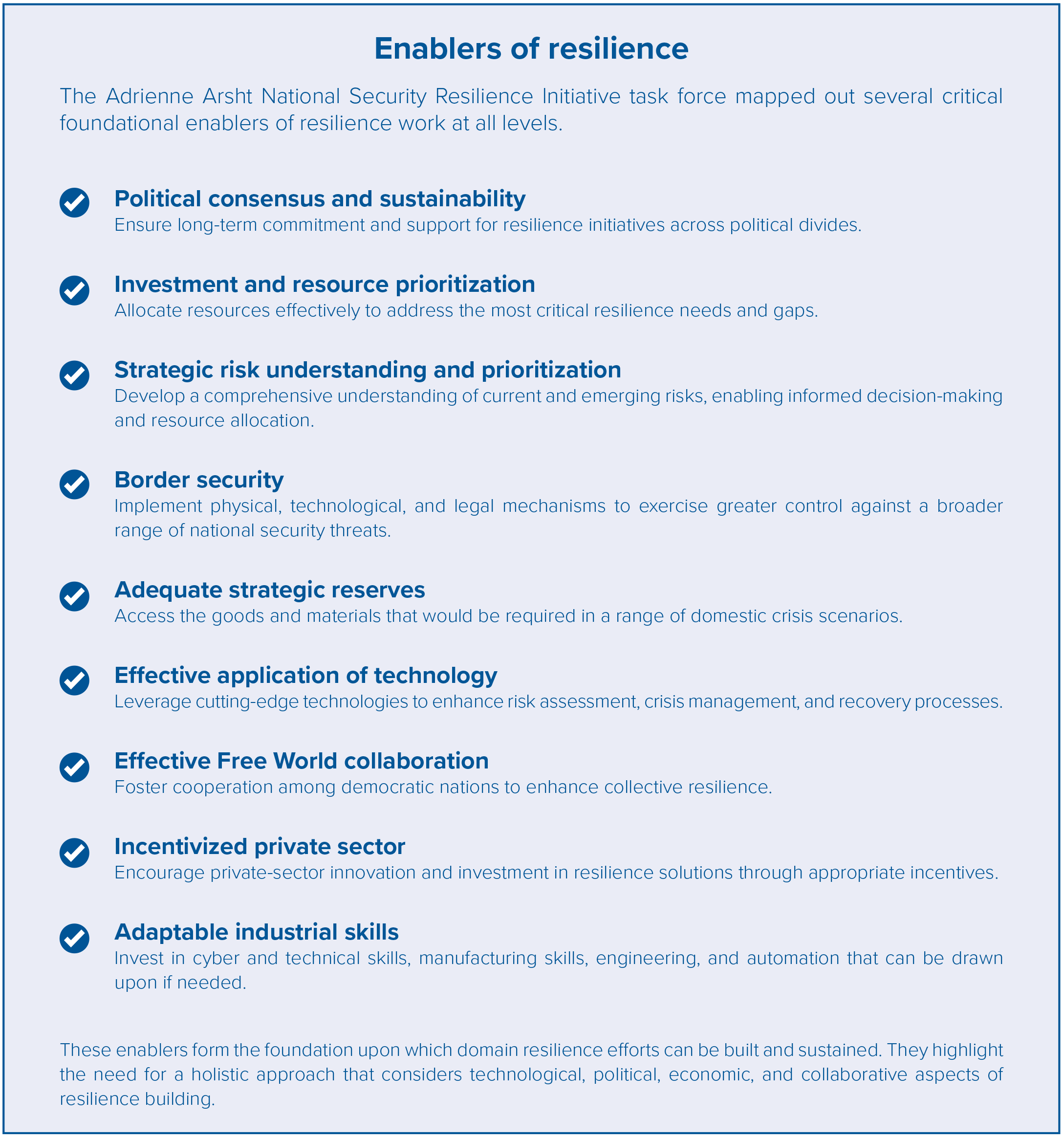
The three danger situations above mirror the panorama of danger that the duty drive anticipates over the approaching months and years. However, these baseline situations don’t account for a variety of further dynamics that more and more complicate resilience constructing. These embrace a scarcity of engagement with the resilience of the person, the instability of strategic partnerships, the accelerating tempo of crises, the challenges of working inside a democratic system, and technological advances. These components make it tougher for governments and establishments to construct sustainable, forward-looking resilience methods.
Back to high

The want for a extra individual-centric strategy
While resilience on the nationwide and worldwide ranges is essential, the capability of people to face up to and adapt to crises kinds the muse of a resilient society. Yet, particular person resilience is formed by deeply private components (psychological, social, financial, environmental, and bodily) that change broadly throughout populations. People with robust help networks, steady employment, and entry to healthcare may be higher geared up to endure crises, whereas these going through monetary hardship, social isolation, or persistent stress may be extra susceptible.
The uneven distribution of those enablers implies that resilience isn’t just a query of particular person nature or willpower however is considerably influenced by exterior circumstances that form folks’s skill to reply to crises and trauma. Early childhood experiences, schooling, neighborhood ties, and publicity to adversity are influential in figuring out resilience outcomes. Early-life trauma, as an example, can weaken a person’s skill to deal with later crises, whereas robust social bonds and entry to psychological well being help can improve restoration and adaptableness. Intergenerational and historic trauma—reminiscent of that skilled by communities affected by slavery, colonization, or displacement—can form stress responses throughout generations, influencing each psychological and organic resilience. Genetic and epigenetic components, which have an effect on how genes are expressed in response to environmental stressors, may also play a task in how people adapt to adversity. These insights recommend that resilience isn’t merely an innate trait however a ability that may be cultivated by focused interventions at particular person, neighborhood, and coverage ranges.
The resilience of these people on the entrance line of safety, security, and democratic free speech is equally important. National safety professionals, navy and intelligence officers, diplomats, medical professionals, and journalists all function beneath intense stress and infrequently cope with advanced and harrowing points. Their capability to face up to and handle psychological pressure is important for each their very own well-being and the effectiveness of their establishments in defending folks. A very resilient nation should spend money on the resilience of those professionals by understanding their lived experiences and making certain they’re supported to stay nicely, succesful, and dedicated for the good thing about all.
Despite the rising give attention to resilience in nationwide safety and coverage discussions, the AANSRI will study the components that allow people to develop and maintain resilience over time. Governments typically prioritize infrastructure hardening and institutional preparedness whereas neglecting the human aspect of making certain that residents are psychologically, socially, and economically geared up to endure crises. Without addressing these individual-level components, broader resilience methods danger failing the very folks they’re meant to guard.
Back to high
Strategic partnerships are beneath pressure in a shifting world order
The worldwide alliances that after offered stability and predictability in safety planning at the moment are beneath rising pressure. Shifting political priorities, financial realignments, and rising strategic divergence amongst US allies and companions make it more durable to keep up long-term resilience efforts. While multilateral establishments reminiscent of NATO, the Group of Seven (G7), the World Health Organization (WHO), and the United Nations (UN) stay essential frameworks for cooperation, inside divisions and misaligned nationwide pursuits have weakened their skill to coordinate resilience efforts throughout borders. For instance, in early 2022, efforts to move strong resolutions within the UN to allow larger humanitarian entry and safety in Ukraine had been watered down or blocked by Russia as a everlasting member of the Security Council.
At the identical time, adversarial states are actively exploiting fractures between allies. Cyber aggression, financial coercion, and covert affect campaigns are getting used to drive wedges between strategic companions, making collective resilience tougher. This is especially evident in provide chain vulnerabilities, as dependencies on adversarial nations in key sectors reminiscent of essential minerals, semiconductors, and power create potential leverage factors for disruption. These pressures are enjoying out throughout a number of strategic relationships.
The Alliance, whereas nonetheless robust, is going through rising coverage divergence on financial safety, commerce, and expertise governance. NATO, historically the bedrock of transatlantic safety, is experiencing calls from each side of the Atlantic to extend European protection burden-sharing, together with an emphasis on nationwide resilience, as present in Article 3 of the founding treaty. As Europe supplies for extra of its personal protection, nationwide resilience amongst NATO members will solely grow to be extra essential for particular person and collective safety. In the Indo-Pacific, the Quad (Australia, India, Japan, and the United States) continues to coordinate efforts in some areas, however there’ll inevitably be variations in priorities for resilience constructing. Meanwhile, the tangible outcomes of G7 efforts to collaborate on key financial safety priorities are nonetheless unfolding.
Still, US alliances have weathered troublesome challenges up to now and will stay an necessary part of advancing shared resilience targets sooner or later. The essential query is how to adapt, develop, or reinvent mechanisms to satisfy present challenges and dynamics.
Back to high
The fast tempo of occasions is a resilience disruptor
Beyond the challenges of alliance instability, the accelerating pace of crises is outpacing governments’ skill to plan and reply successfully. Geopolitical conflicts, technological shifts, and financial shocks are unfolding at a price that strains resilience frameworks, which had been designed for slower-moving dangers.
This problem is additional compounded on the worldwide degree, the place multilateral establishments and cooperative mechanisms typically function at a tempo ill-suited to the urgency of contemporary threats. Organizations such because the UN, NATO, and the G7 play necessary roles in resilience coordination, however their decision-making processes are regularly constrained by consensus necessities, political divergence, and bureaucratic inertia. As crises grow to be extra advanced and transfer sooner, these establishments danger changing into irrelevant except they evolve to match the pace and scale of rising dangers.
To stay efficient, worldwide resilience efforts should grow to be extra agile, permitting for sooner decision-making, extra versatile coalitions, and the mixing of bilateral initiatives when multilateral consensus is simply too gradual or ineffective. Without significant reform, conventional mechanisms of worldwide collaboration will wrestle to offer the resilience help that nations require, forcing states to hunt various frameworks that may reply on the essential pace and scale.
Back to high
Democracy is an asset and a problem for resilience
Democratic techniques have distinct benefits for constructing resilience. The decentralized nature of energy permits accountability to be distributed throughout authorities, civil society, and the non-public sector, making disaster responses extra versatile and adaptable. Local and regional actors can take unbiased initiative, making certain that resilience efforts are usually not depending on a single level of failure. NGOs are inspired to play a essential position in native resilience and are supported in these efforts.
The free circulation of knowledge can also be an enormous asset. Open discourse, unbiased media, and transparency allow early danger detection and efficient disaster response. Unlike authoritarian regimes that suppress inconvenient truths, democracies encourage debate and studying, serving to refine methods over time. Public belief can also be a essential asset. In democratic techniques, citizen engagement in decision-making tends to foster greater belief and legitimacy, which in flip helps voluntary compliance with emergency measures and long-term restoration. Autocratic techniques might guarantee compliance by concern and drive, democracies construct resilience by consent.
Case research: The Thames Barrier
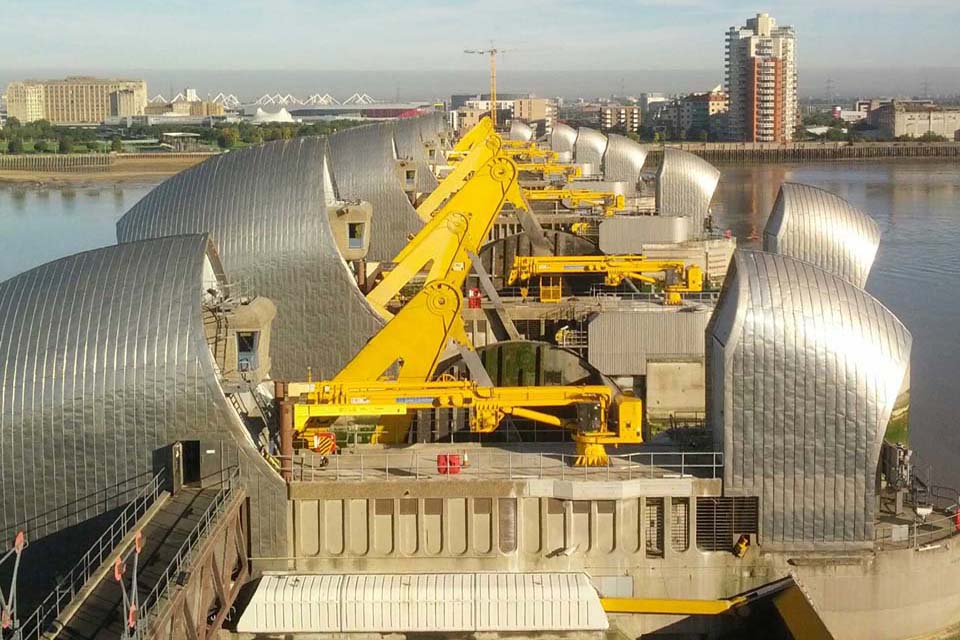
Democracies can and do succeed at long-term resilience planning when the danger is nicely understood and a political consensus and can to behave are developed. The Thames Barrier in London, constructed between 1974 and 1984, is a good instance of sustained motion to cut back danger over time. This movable flood protection was developed in response to the devastating North Sea flood of 1953, which claimed greater than 300 lives within the United Kingdom. The barrier protects 125 sq. kilometers of central London, together with essential infrastructure and £321 billion value of residential property, from tidal surges and storm floods.
This set off occasion galvanized politicians throughout the spectrum, with successive Labour and Conservative governments depoliticizing the difficulty and conserving the challenge funded and on monitor. The Thames Barrier’s success stems from clear governance, public accountability, and adaptive planning. In distinction to autocratic techniques, the place fast implementation can overlook long-term sustainability, the Thames Barrier showcases how democratic processes and political management emphasizing stakeholder engagement, transparency, and adaptableness can result in enduring and efficient resilience infrastructure.
Democracies should discover new methods to commerce on the strengths of techniques to enhance resilience, whereas balancing electoral accountability with long-term resilience methods, making certain preparedness stays a precedence regardless of political turnover.

Back to high
Fragmentation of resilience accountability
One of essentially the most important challenges to resilience is fragmentation, wherein accountability for managing dangers is dispersed throughout a number of establishments, sectors, and ranges of presidency with restricted coordination. In many democracies, resilience-related capabilities reminiscent of cybersecurity, catastrophe response, infrastructure safety, and countering disinformation are divided amongst authorities companies, non-public firms, and native authorities—typically with misaligned priorities, unclear obligations, and restricted mechanisms for collaboration. Although largely unavoidable, this lack of unity could make it more durable to anticipate, stop, and reply successfully to crises.
Beyond authorities, a lot of a nation’s resilience energy resides in civil society, companies, and native communities. Private-sector actors personal and function the vast majority of essential infrastructure, but their danger calculations are sometimes pushed by market forces reasonably than nationwide safety imperatives. Meanwhile, native governments and neighborhood organizations are regularly on the entrance traces of disaster response however may lack the required assets, authority, or integration into nationwide resilience methods. These silos can gradual decision-making and create vulnerabilities that adversaries can exploit.
To overcome this, the United States wants a basic shift in how resilience is structured and managed. Rather than simply allocating obligations, governments should activate all layers of the resilience structure supporting them to work together in ways in which reinforce and allow each other. This means
- making certain vertical integration, in order that resilience efforts on the nationwide, regional, and native ranges are aligned and mutually reinforcing;
- strengthening horizontal coordination throughout sectors, making certain that essential industries, authorities companies, and civil society organizations work in live performance reasonably than in isolation; and
- creating mechanisms for shared consciousness and adaptive studying in order that resilience actors in any respect ranges can anticipate rising threats, alter methods in actual time, and help each other’s efforts.
There is precedent for such strong collaboration. Launched in response to the COVID-19 pandemic, Operation Warp Speed (OWS) introduced collectively federal companies, navy logistics, and personal pharmaceutical firms to speed up vaccine improvement, manufacturing, and distribution. This public-private partnership initiated by the US authorities in May 2020 overcame bureaucratic and logistical limitations to ship secure, efficient vaccines in file time. The initiative demonstrated how aligning authorities help with private-sector innovation can quickly construct nationwide resilience within the face of a public well being disaster, making a blueprint for future efforts.
A extra interconnected resilience ecosystem is important to navigating the advanced threats of the long run. Without it, resilience efforts will stay fragmented, reactive, and susceptible to disruption.
Case research: The Texas energy grid
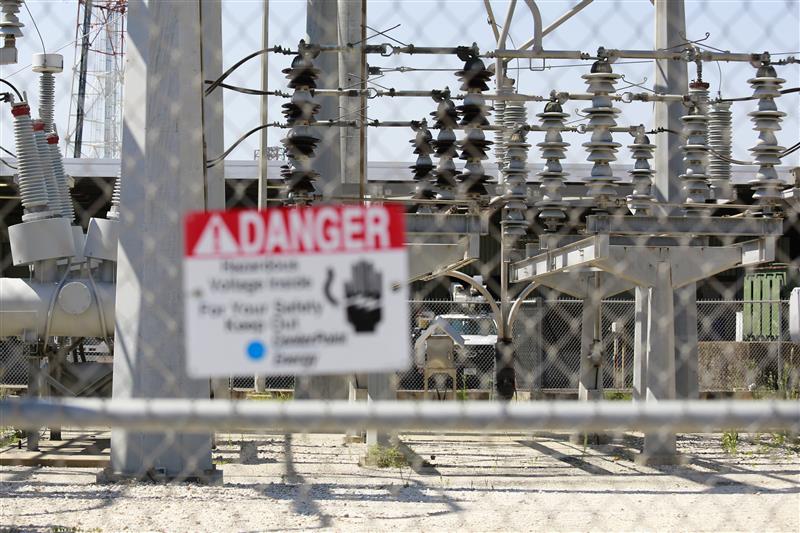
The devastating 2021 Texas energy grid failure was a catastrophe for the state. In the aftermath of the catastrophe, the state reported greater than 2 hundred deaths and as much as $195 billion in damages. The roots of the failure may be present in Austin’s power regulation technique, a singular strategy that left it susceptible to catastrophe and unable to face up to the shocks of elevated demand.
In the Nineties, the Texas state authorities determined to decentralize its grid, prioritizing a aggressive, market-based system of transmission operators and power retailers. This resulted in decrease power costs for customers however, with a need to maintain costs low, the businesses working the grid lacked incentives to spend money on upkeep, upgrades, and basic oversight. At the peak of the disaster, 4.5 million clients had been with out energy, and the grid was solely 4 and a half minutes away from complete failure.
In the lead-up to the disaster, authorities flagged that the grid was not sufficiently winterized and lacked waterproofing that may enable it to face up to snow and ice. Further exacerbating the disaster, the Texas grid operates independently of the ability grids of different states. This is by design, minimizing the quantity of federal oversight and regulation required, but in addition meant that the Texas grid was unable

Back to high
Technology as an enabler—and a menace—to resilience
Technology presents each a problem and a chance. While digital developments can improve resilience, in addition they introduce new vulnerabilities, from cyber threats to the fast unfold of misinformation. Digital developments can bolster preparedness and response by enhancing early warning techniques, bettering disaster coordination, and securing provide chains. But in addition they introduce vulnerabilities that may undermine these efforts.
Cyber threats pose one of the vital rapid challenges to nationwide resilience. The 2021 ransomware assault on the Colonial Pipeline disrupted gasoline provides throughout the US east coast and highlighted the susceptibility of essential infrastructure to cyber threats. And these threats are evolving beneath the course of hostile states. China has been utilizing superior applied sciences and persistently attacking essential nationwide infrastructure in democracies, particularly concentrating on communications, power, and transportation techniques. China’s Volt Typhoon operation has efficiently compromised a variety of US infrastructure. And China isn’t alone in searching for to use cutting-edge expertise to its benefit. For instance, latest reviews point out that North Korea has established Research Center 227, a unit devoted to growing offensive hacking applied sciences and packages, together with these leveraging artificial intelligence (AI).
Looking forward, the resilience challenges posed by quantum computing might be much more profound. Advances in quantum expertise have the potential to interrupt present encryption requirements, threatening the safety of monetary techniques, authorities communications, and delicate knowledge. Democracies are already engaged on post-quantum cryptography to counter this danger, however the transition will take time, and adversarial actors may exploit weaknesses earlier than defenses are absolutely in place.
Beyond the digital sphere, bioengineering and robotics introduce completely new dimensions of danger. Synthetic biology might be used to develop engineered pathogens, blurring the road between pure pandemics and deliberate organic threats. At the identical time, advances in autonomous techniques and robotics may revolutionize warfare, elevating issues about weaponized AI-driven techniques working past human management. The intersection of those scientific fields—quantum computing, AI, bioengineering, and robotics—presents unknown dangers to resilience and nationwide safety.
At a extra fundamental degree, public platforms and ubiquitous expertise may be exploited to undermine resilience and disaster response. For instance, the fast unfold of misinformation on social media platforms throughout crises can erode public belief and complicate efficient responses, as seen through the COVID-19 pandemic. Off-the-shelf drone expertise has disrupted air journey and brought about large concern about reconnaissance and even weapon deployments in opposition to home targets.
To construct true resilience, it’s essential to mitigate at present’s technological threats, anticipate how rising applied sciences will form the long run danger panorama, and absolutely perceive how expertise shapes each strengths and vulnerabilities.
Back to high
The structure of resilience
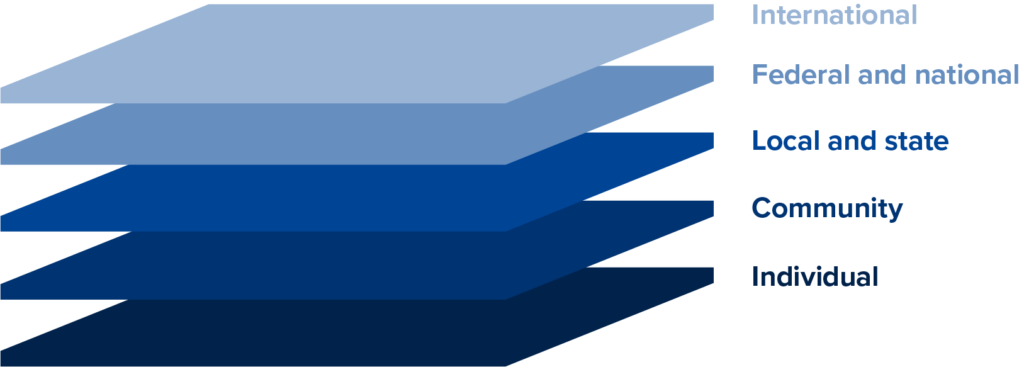
Resilience is a multi-layered ecosystem requiring participation at totally different ranges of society, from people and communities to states and the worldwide order. Each layer performs a definite position in absorbing, adapting to, and recovering from disruptions, and resilience can’t be actually efficient except it’s developed holistically throughout these ranges.
At the person degree, resilience is formed by psychological, social, financial, and genetic components that decide how folks reply to crises. Individuals with robust help networks, adaptive mindsets, and financial stability are higher geared up to face up to and get better from shocks. However, particular person resilience doesn’t exist in isolation; it’s influenced by the buildings and assets accessible inside communities and broader techniques.
Community resilience builds on this basis by fostering social cohesion, native preparedness, and collective problem-solving. Strong communities function the primary line of response in crises, offering casual help networks that complement institutional responses. Yet, communities require coverage help, infrastructure, and funding to keep up their skill to perform beneath stress.
At the native and state ranges, resilience is determined by governance buildings, coordination mechanisms, and useful resource allocation. Effective native resilience requires a well-integrated strategy that ensures cities, states, and nationwide authorities work collectively to mitigate dangers. However, governance fragmentation typically weakens resilience efforts, with obligations break up throughout establishments which may lack clear coordination. This is especially evident in disaster response situations, wherein native authorities—with out nationwide help—may lack the capability or funding to behave swiftly.
National resilience integrates all these layers, making certain that resilience isn’t solely constructed on the neighborhood degree however can also be embedded in nationwide safety methods, financial insurance policies, and infrastructure planning. This degree of resilience requires governments to prioritize long-term danger discount, balancing funding in essential infrastructure, cybersecurity, and strategic reserves whereas sustaining the agility to reply to rapid crises. However, as mentioned earlier, short-term political incentives typically hinder sustained funding, making nationwide resilience a posh problem.
Finally, worldwide resilience displays the truth that no nation operates in isolation. Global crises—whether or not pandemics, cyberattacks, or geopolitical conflicts—demand coordinated responses throughout borders. Resilience at this degree is formed by alliances, multilateral cooperation, and shared risk-management methods. However, geopolitical tensions, financial competitors, and diverging nationwide pursuits typically restrict the effectiveness of worldwide resilience efforts, making collaboration difficult even when threats are transnational.
All of those layers are interdependent; weak spot at any degree undermines the resilience of the entire. To create a really resilient society, resilience should be handled not as a siloed idea however as a structural framework, integrating people, communities, governance, nationwide safety, and worldwide cooperation right into a unified strategy to danger and preparedness.

Back to high
Part 2: Shaping the response
Individual resilience: The basis of nationwide energy
At the guts of the AANSRI lies a easy reality: a nation can’t be resilient except its persons are resilient. Governments can construct robust establishments, spend money on infrastructure, and create insurance policies to mitigate danger, however the nation will stay susceptible if people lack the capability to face up to and adapt to crises. Individual resilience isn’t solely about private survival; it’s the basis upon which neighborhood, state, and nationwide resilience are constructed. Without it, all different layers of resilience are compromised.
Resilience on the particular person degree is formed by a number of key components, together with psychology, social help, sensible safety, and genetics. The resilience of the person is inextricable from neighborhood resilience, of which features of social community help are lined in larger element beneath.
Psychological resilience, which is commonly described as psychological toughness or emotional endurance, determines how nicely people reply to stress, uncertainty, and trauma. Those with naturally adaptive mindsets, problem-solving abilities, and emotional regulation usually tend to navigate crises successfully. However, psychological resilience doesn’t develop in isolation; it’s strengthened or weakened by social situations and the provision of sensible assets.
Despite the significance of particular person resilience, it’s typically neglected in nationwide safety and coverage discussions. Governments are inclined to give attention to macro-level resilience methods, assuming that institutional energy will translate into societal resilience. But insurance policies, methods, and emergency plans are solely as efficient because the individuals who should implement and reply to them. Without higher understanding of, and funding in, the resilience of people by schooling, the United States is lacking a significant piece of the puzzle.
A core argument of the AANSRI is that resilience should start on the particular person degree. Strengthening people strengthens communities—which, in flip, reinforces native, nationwide, and worldwide resilience. This initiative locations particular person resilience on the middle of a nationwide safety dialog, recognizing that resilient nations are constructed from the bottom up.
Case research: A nationwide safety analyst’s story
For almost a decade, Maya, a mid-career nationwide safety analyst, thrived in a high-stakes federal company recognized for its demanding tempo and mission-critical work. Tasked with coordinating real-time intelligence throughout a quickly escalating worldwide disaster, she typically labored fourteen-hour days in safe services, balancing categorized briefings, pressing decision-making, and the burden of figuring out that lives trusted well timed, correct evaluation.
Over time, this cumulative stress started to take a toll. Maya skilled persistent insomnia, emotional detachment, and problem concentrating—early indicators of burnout she initially ignored. In a subject the place stoicism is commonly mistaken for energy, searching for assist felt dangerous. Still, she quietly reached out to her company’s inside wellness workforce and was related with a resilience coach by a pilot program developed for high-performing employees in essential roles.
The intervention proved transformative. Maya realized instruments drawn from cognitive-behavioral science to handle stress and enhance focus. She additionally joined a peer help group for nationwide safety professionals, wherein she may communicate candidly about her experiences for the primary time. Through structured teaching and casual connection, she reframed her stress response from one thing shameful to one thing manageable—and even instructive.
With time and help, Maya returned to her position with renewed readability and a deeper understanding of what sustainable efficiency seems like. She grew to become a champion for integrating resilience practices into workforce workflows—advocating for debriefing rituals and versatile scheduling the place potential, and inspiring early-career employees to make use of the wellness assets she as soon as hesitated to discover.
Maya’s story underscores a core perception from resilience science: it’s not the absence of stress, however the presence of help, abilities, and self-awareness that makes the distinction. In mission-driven environments reminiscent of nationwide safety, the place the price of burnout is excessive and the stigma round searching for assist stays, particular person resilience isn’t a luxurious—it’s a strategic crucial.
Strong people make robust nations: Recommendations for the AANSRI
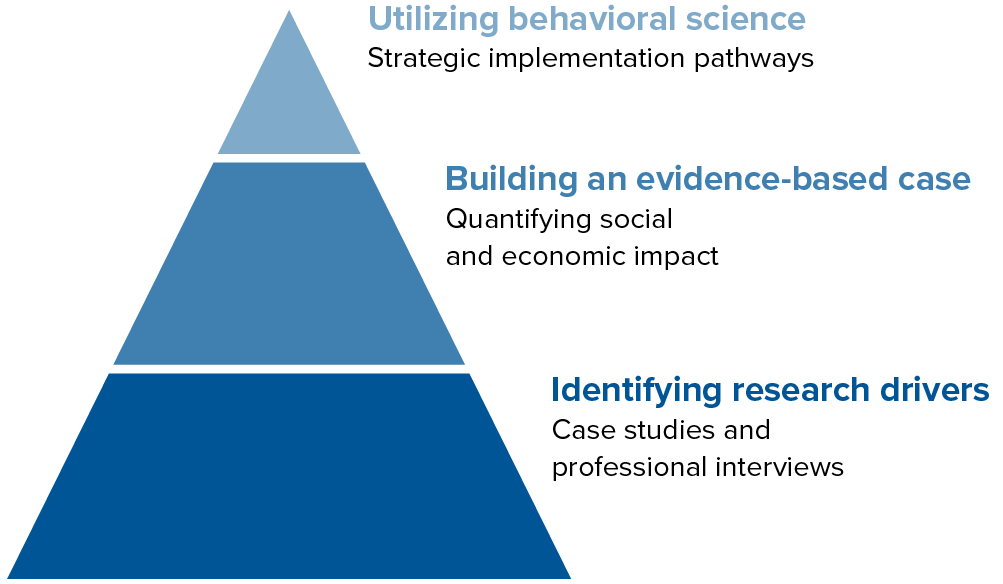
1. Conduct analysis on the drivers of particular person resilience.
- Perform a complete evaluation of resilience components.
- Develop and analyze case research. Draw from each home (US) and worldwide examples to match resilience-building approaches throughout totally different cultural and coverage contexts.
- Distinguish between innate psychological traits (e.g., temperament, cognitive flexibility, and genetics) and exterior social influences (e.g., neighborhood, schooling, and institutional help) that improve or hinder particular person resilience.
- Conduct focused analysis interviews with professionals in high-stress fields the place resilience is essential. This ought to embrace navy and intelligence personnel, journalists working in battle zones, frontline medical employees (e.g., emergency room medical doctors, paramedics, and catastrophe response groups), and humanitarian employees in disaster zones.
2. Build an evidence-based case for particular person resilience.
- Quantify social and financial impacts.
- Commission analysis and financial modeling to evaluate the price of low resilience (e.g., elevated psychological well being points, diminished workforce productiveness, and larger reliance on authorities help in crises) and the financial and social advantages of resilience-building measures.
- Integrate coverage, utilizing findings to advocate for coverage shifts that acknowledge resilience as a strategic asset, integrating it into schooling, workforce coaching, and public well being initiatives.
3. Apply behavioral science to strengthen resilience.
- Analyze cross-sector conduct.
- Examine how behavioral science is used efficiently in different coverage areas (e.g., well being, safety, and catastrophe preparedness) and determine greatest practices.
- Develop strategic implementation pathways with sensible coverage suggestions that might be carried out at nationwide and state ranges (e.g., public consciousness campaigns, resilience schooling in colleges, and office stress-management insurance policies) or by private-sector actors, notably social media firms, to discover how digital platforms may foster resilience-building behaviors reasonably than exacerbating stress and division.
4. Highlight and elevate the voices of people who’ve been in a position to bounce ahead from adversity to convey the significance of particular person resilience to a basic viewers.
- The AANSRI may produce a Profiles in resilience video collection that spotlights people within the nationwide safety neighborhood who’ve confronted important hardships or skilled particularly difficult circumstances in the midst of their work. Importantly, this collection ought to intention to focus on the teachings in resilience interviewed individuals can draw from these experiences.

Back to high
Resilient communities: The social core of nationwide safety
While particular person resilience is the muse of a resilient nation, communities act as the primary line of protection in occasions of disaster. A well-connected, engaged neighborhood can soak up shocks, adapt to disruptions, and get better extra successfully than people performing alone. Community resilience is constructed on belief, native management, shared assets, and the flexibility to mobilize shortly in response to emergencies.
Strong communities improve resilience by offering mutual help networks that complement authorities responses. Whether by casual networks of neighbors, faith-based organizations, or structured civil society teams, resilient communities act as drive multipliers in occasions of disaster.
However, communities face important limitations to resilience, together with financial disparities, political disengagement, and lack of native funding. In many circumstances, essentially the most susceptible communities are additionally the least geared up to organize for, reply to, and get better from crises. Governments typically assume that resilience will develop organically. But with out deliberate efforts to strengthen neighborhood capability, social cohesion can shortly erode beneath stress.
Social resilience stems from the networks and relationships people depend on in occasions of disaster. Strong communities, household ties, and help techniques act as buffers, lowering the affect of exterior shocks. Studies on catastrophe restoration have constantly proven that people embedded in cohesive social networks (together with digital networks) fare higher than those that are remoted.
Resource stability is equally essential. Individuals residing in poverty or monetary precarity have fewer assets to soak up shocks, whether or not from job loss, well being crises, or pure disasters. This isn’t just about revenue; it contains entry to schooling, healthcare, and monetary literacy, all of which decide a person’s skill to plan, adapt, and get better. Local NGOs can play a essential position in assembly the useful resource hole for much less well-equipped people. When a disaster manifests at a neighborhood degree, faith-based organizations and different neighborhood teams are sometimes important in each preparedness and response actions.
Another main problem is the fragmentation between native initiatives and nationwide insurance policies. While governments might need nationwide resilience methods, these don’t at all times translate into localized, community-driven preparedness efforts. Effective resilience constructing requires a bottom-up strategy, wherein nationwide insurance policies help and empower native leaders, grassroots organizations, and community-driven risk-reduction efforts.
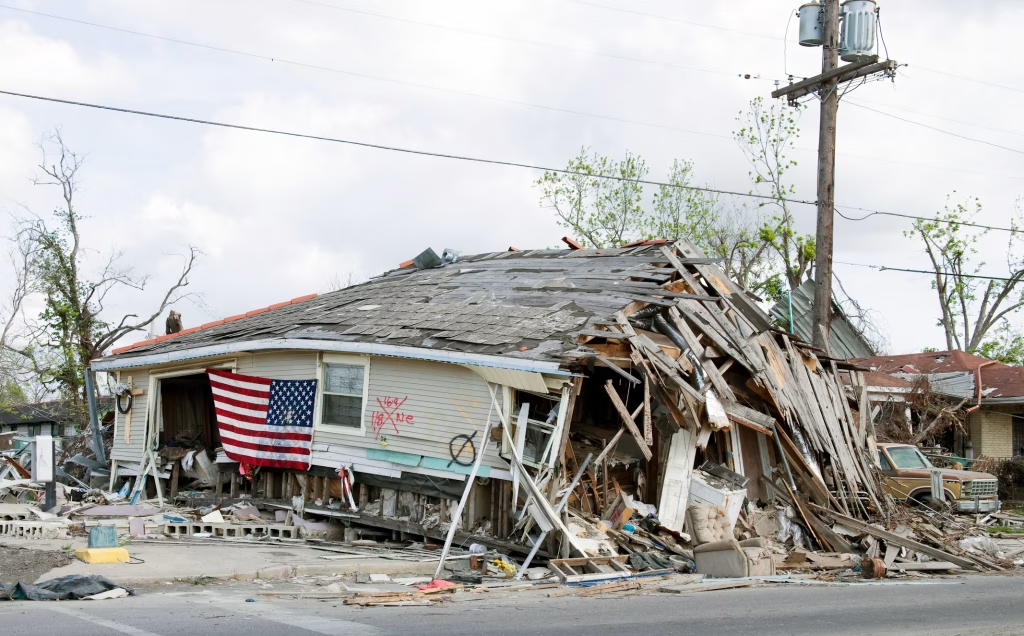
Case research: Hurricane Katrina
Elected authorities didn’t adequately put together the Gulf Coast for Hurricane Katrina. Combined with uneven restoration efforts, perceptions of resilience shifted the main focus towards community-led restoration. Responding to Katrina’s devastation actually took a village—from actor Matthew McConaughey rescuing a neighborhood anesthesiologist and fifty stranded pets from a hospital with out meals or operating water for seven days, to neighborhood teams uniting to rebuild colleges after the storm left solely 17 % of New Orleans colleges operational.
Across the Gulf Coast, residents developed robust social bonds, creating resilient communities able to help one another amid recurring disasters. Today, when storms strike neighboring areas, volunteer teams just like the Cajun Navy mobilize swiftly, bringing private “airboats, duck boats, fishing skiffs, and even kayaks” to carry out search-and-rescue missions. These efforts have confirmed important, particularly when rising waters entice folks on rooftops.
One may assume residents of New Orleans and surrounding areas have grow to be hardened after such important loss, however the reverse has occurred. A profound sense of neighborhood help and empathy now characterizes the area, shaping each catastrophe restoration and on a regular basis interactions. The resilience cultivated after Hurricane Katrina illustrates the extraordinary energy of neighborhood ties in overcoming adversity.

The position of communities: Recommendations for the AANSRI
1. Develop comparative case research that study profitable neighborhood resilience fashions from the United States and internationally, figuring out key components that strengthen resilience throughout totally different social, financial, and governance contexts.
2. Map vulnerabilities to grasp which geographical areas want the best further help from exterior.
3. Conduct social analysis on strengthening neighborhood bonds. Explore what fosters robust, related communities and the way these components contribute to neighborhood preparedness (how social cohesion influences readiness for crises), disaster response capability (how networks mobilize shortly when disasters strike), and long-term restoration (how social ties help rebuilding efforts and scale back long-term vulnerabilities).
4. Investigate how formal and casual native management—reminiscent of mayors, religion leaders, neighborhood organizers, and enterprise leaders—helps resilience efforts.
- Focus on which management traits and approaches improve neighborhood preparedness and the way management may be developed and inspired at a grassroots degree.
5. Develop strategic suggestions for state, nationwide, NGO, and private-sector help.
- Assess the simplest types of exterior help.
- Identify what state, federal, and NGO interventions are simplest in enhancing neighborhood preparedness for emergencies, supporting fast response and restoration when crises happen, and empowering native communities reasonably than creating dependency.
6. Maximize affect by monetary funding; analysis the place funding and assets needs to be directed to generate essentially the most important nationwide affect.
- Assess if funding ought to give attention to infrastructure, coaching, social packages, or disaster communication techniques.
- Understand how monetary incentives can encourage community-led resilience tasks.
7. Leverage expertise for resilience constructing to bridge the gaps between nationwide course and neighborhood resilience. Explore the position of digital instruments and improvements in strengthening resilience, together with
- early warning techniques and disaster communication platforms;
- social media and neighborhood apps for coordination throughout emergencies;
- data-driven danger assessments to assist communities put together and adapt; and
- the position of knowledge and danger evaluation at a neighborhood degree.
8. Develop instruments to facilitate resilience literacy in communities.
- Explore how native communities entry and interpret danger info most successfully.
- Study how to promote higher danger literacy amongst residents.
- Investigate what info (and information-sharing buildings) would enhance native preparedness and response.
Back to high
Empowering state and native resilience: The operational frontline
Resilience on the native and state ranges performs a essential position in connecting community-based preparedness efforts with nationwide safety methods. Local and state governments are often the primary to reply to crises, whether or not pure disasters, public well being emergencies, or safety threats. They function the operational spine of resilience, coordinating between federal assets, private-sector actors, and native communities.
However, regardless of their central position, native and state governments typically wrestle with fragmented obligations, inconsistent funding, and bureaucratic inefficiencies. Many resilience efforts undergo from a scarcity of coordination between totally different ranges of presidency, with native and state actors regularly ignored of nationwide safety planning processes. If resilience is to be actually efficient, native and state buildings should be higher built-in, correctly resourced, and empowered to behave decisively.
Under President Donald Trump’s administration, there was a notable shift in catastrophe preparedness obligations from federal companies to state and native governments. An govt order signed on March 18, 2025, emphasizes that “preparedness is most effectively owned and managed at the state, local, and even individual levels,” thereby lowering the Federal Emergency Management Agency’s (FEMA) direct involvement in catastrophe preparations. This coverage change goals to empower native entities to make infrastructure choices tailor-made to their particular wants, resulting in extra environment friendly use of assets.
This transition has raised issues concerning the capability of state and native governments to shoulder elevated obligations with out substantial federal help. Critics argue that diminishing FEMA’s position may depart communities susceptible, particularly these missing the monetary assets to spend money on essential infrastructure and preparedness measures. The govt order additionally requires revising essential infrastructure insurance policies to higher mirror assessed dangers, shifting away from a generalized all-hazards strategy. While this technique seeks to streamline catastrophe preparedness, it may also end in disparities in readiness throughout totally different areas, relying on their particular person danger assessments and useful resource allocations. New funding gaps ensuing from a radical discount of FEMA may take a very long time to fill. State legislatures may not be capable to act swiftly, which might incur important interim danger.
Local and state resilience is determined by 4 key pillars.
1. Coordination and disaster response capability
- Local and state governments should be capable to act shortly and decisively in a disaster. However, many undergo from gradual bureaucratic processes, unclear chains of command, and restricted autonomy in decision-making. The skill to coordinate emergency response throughout a number of jurisdictions is important for resilience.
2. Infrastructure and funding in danger discount
- Physical and digital infrastructure play main roles in resilience. Roads, power grids, water techniques, and cybersecurity frameworks should be designed to face up to shocks and get better shortly. However, resilience investments typically take a backseat to extra rapid political priorities, leaving essential infrastructure susceptible to failure.
3. Legislation and coverage help
- Effective resilience constructing requires robust coverage frameworks on the state and native ranges. Laws associated to catastrophe preparedness, constructing codes, emergency funding, and data sharing can considerably improve native resilience. However, many jurisdictions lack the authority or assets to implement such insurance policies constantly. For instance, it has proved troublesome to fight China’s efforts to buy land close to US and allied navy bases as a result of, at a neighborhood degree, there may be much less entry to intelligence or technical functionality to determine and handle the danger.
4. Public belief and neighborhood engagement
- State and native governments should interact the general public in resilience efforts. Without clear communication and public belief, emergency response efforts can face resistance or confusion. Strengthening native resilience means making certain that residents perceive their position and believe of their native management.
- Despite their essential position, native and state resilience efforts are regularly underfunded and under-prioritized.
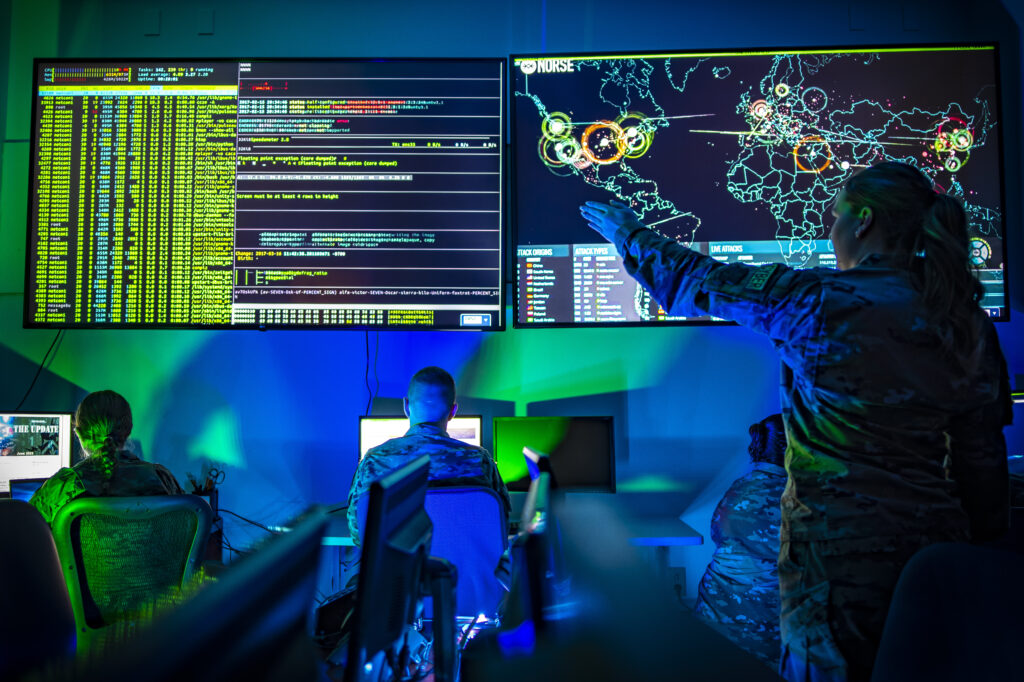
Case research: The Ohio Cyber Reserve
In 2022, Ohio Governor Mike DeWine issued an govt order that directed the creation of a brand new, cabinet-level place of cybersecurity strategic advisor to guide the state’s cybersecurity efforts throughout companies, together with the event of the Ohio Cyber Reserve (OhCR). The OhCR was established beneath the Ohio Adjutant General, the manager department of the Ohio state authorities that oversees the Ohio National Guard. The OhCR is an all-volunteer civilian drive organized round three missions—help, educate, and reply—which all make the OhCR an company aware of cybersecurity points across the state. Further complementing Ohio’s resilience to cyber threats was the creation of the Ohio Cyber Integration Center, which sits inside the Ohio Adjutant General and coordinates the state’s responses to cyber threats, serving as a central hub and coordination middle. These initiatives, alongside the OhCR, all contribute to the state’s cyber resilience. They mix schooling and consciousness with job creation and financial improvement to create a extra resilient Ohio.

Local and state resilience: Recommendations for the AANSRI
1. Map native resilience capability and governance gaps.
- Complete comparative evaluation of native resilience governance. Conduct a multi-region research of how totally different state and municipal governments construction their resilience planning, funding, and disaster response. Identify greatest practices and key gaps in preparedness.
- Develop a local-state resilience index. Create a standardized resilience index to measure preparedness, coordination capability, and restoration effectiveness throughout totally different states and municipalities. This may function a instrument for benchmarking and guiding useful resource allocation.
2. Design smarter national-to-local resilience methods.
- Evaluate the 2025 govt order’s affect and analyze the shifting stability of obligations from federal to state governments. Determine what sensible coverage and operational selections would help the drive to “streamline preparedness operations; update relevant Government policies to reduce complexity and . . . enable State and local governments to better understand, plan for, and ultimately address the needs of their citizens.”
- Determine what capabilities can solely be carried out on the federal degree (e.g., large-scale intelligence and strategic coordination) and the place states can take larger accountability.
- Explore progressive financing fashions for native resilience. Explore various funding mechanisms for resilience tasks, together with public-private partnerships (PPPs) for infrastructure resilience, municipal resilience bonds, and philanthropic and affect funding methods to help resilience initiatives.
3. Optimize disaster coordination between state and native authorities.
- Understand classes from previous disaster responses by conducting case research on profitable and failed coordination efforts in state-level crises (e.g., hurricanes, cyberattacks, and wildfires). Identify systemic weaknesses and develop insights into what allows efficient coordination.
- Improve intelligence and resource-sharing mechanisms by inspecting how state and federal companies can guarantee well timed info sharing, notably in quickly evolving crises (e.g., cyber incidents, coordinated assaults, and power grid disruptions).
4. Simulate a malicious-origin cascading disaster affecting a number of states. While most crises happen naturally, the Colonial Pipeline cyberattack and different state-backed disruptions spotlight the necessity to research threat-based resilience.
- Develop a two-day resilience simulation. Design and execute a multi-stakeholder train partaking federal, state, and native authorities, neighborhood organizations, emergency responders, and protection, intelligence, and cybersecurity specialists.
- The simulation ought to check how cascading failures throughout sectors (e.g., power, finance, transportation, and provide chains) affect state resilience and what coordination buildings are simplest in mitigating affect. Expose any gaps in info sources, system connections, insurance policies and regulations, or sensible help.
Back to high
National management: The strategic structure of resilience
At the nationwide degree, resilience is about making certain {that a} nation’s establishments, infrastructure, financial system, and safety equipment can stand up to, adapt to, and get better from crises. National resilience is the product of people, communities, and native and state efforts which are supported and enabled on the nationwide degree. This mixed effort is the strategic spine that allows societies to perform beneath stress, whether or not going through financial shocks, cyber threats, political instability, pure disasters, or navy aggression.
However, governments typically wrestle to embed resilience into nationwide safety methods in a significant means. The problem lies in competing coverage priorities, short-term political incentives, and the issue of justifying resilience investments when crises are hypothetical reasonably than imminent.
As the latest presidential govt order illustrates, a lot of what must be accomplished sits exterior of the federal and nationwide authorities area. As the United States develops a brand new resilience technique, it is going to be necessary to attach the dots with different areas of nationwide safety technique, coverage, and operations. Resilience work requires a totally collaborative and cross-cutting nationwide strategy. Understanding and clearly articulating and supporting the relative roles of companions in any respect layers of the resilience structure is a essential basis to success.
There will at all times be some strategic capabilities that should be carried out on the middle of presidency for the good thing about the entire nation.
1. Strategic danger administration
- Governments should constantly assess and articulate a strategic understanding of dangers, develop nationwide technique, and set clear expectations about precedence actions.
- The nationwide degree additionally performs a essential position in understanding progress and adapting to occasions.
- National governments may encourage and interact civic efforts with efficient communication methods and workout routines. (For instance, Taiwan has civil protection drills to lift inhabitants consciousness and preparedness.)
2. Border administration and resilience
- The federal authorities performs a singular position in securing and managing the nation’s borders as a core perform of nationwide resilience. Effective border administration is important for sustaining nationwide sovereignty, financial stability, and public security. Unlike different ranges of governance, solely the federal authorities has the authority and assets to coordinate nationwide border safety technique, implement immigration legal guidelines, and defend essential infrastructure at ports of entry. This contains
- figuring out and managing transnational threats reminiscent of organized crime, human trafficking, drug smuggling, and adversary-led infiltration efforts;
- investing in infrastructure and expertise;
- coordinating disaster response, together with managing large-scale migration surges, health-related border threats, and disruptions to cross-border commerce by coordinated federal motion; and
- main intelligence integration and federal-state cooperation by, for instance, strengthening info sharing amongst federal companies, state governments, and allied nations to boost border safety and disaster preparedness.
3. Resilient infrastructure, provide, and manufacturing functionality
- The full image of the resilience of essential infrastructure (power grids, provide chains, water techniques, digital networks, and so on.) can solely be introduced collectively at a nationwide degree the place gaps may be recognized and course set.
- Macro industrial technique can have main affect on core resilience priorities. For instance, incentivizing home manufacturing in key areas reminiscent of battery or semiconductor manufacturing, or power manufacturing and storage, decreases reliance on politically or geographically unstable areas.
4. Political stability and institutional resilience
- Resilience isn’t just about bodily property; it additionally is determined by the energy of (and belief in) democratic establishments, governance buildings, and public belief in management.
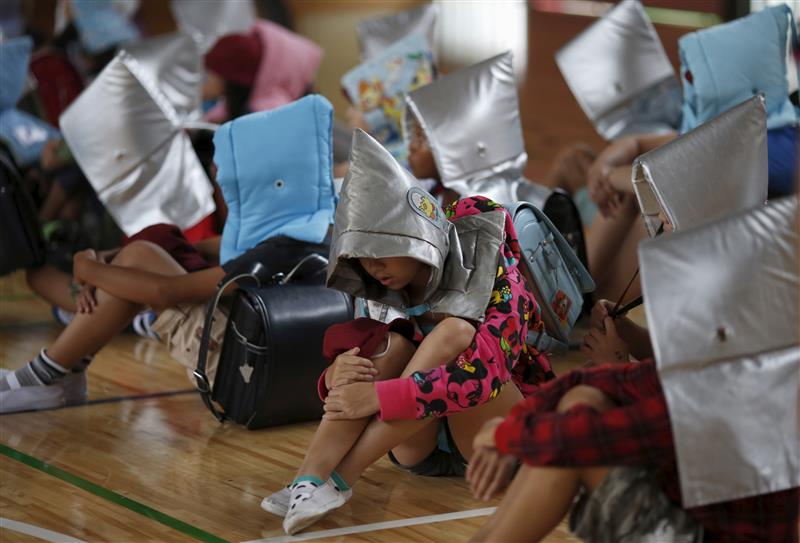
Case research: Japan’s earthquake program
Japan has a deeply embedded tradition of resilience that started with the Great Kanto Earthquake of 1923, which left roughly 140,000 folks useless. In the aftermath, Japan acknowledged the need of essentially reshaping its infrastructure, its nationwide psyche, and its strategy to catastrophe preparedness.
Japan crafted a complete blueprint for earthquake resilience. The Japanese authorities established “Disaster Prevention Day” on September 1 of every yr, commemorating the Great Kanto Earthquake and reinforcing collective reminiscence and preparedness by requiring colleges, companies, and communities to take part in earthquake and tsunami drills. These common drills are extra than simply procedures—they serve to ingrain a mindset of readiness into each particular person, reinforcing Japan’s communal accountability in catastrophe response.
The magnitude 9.0 earthquake of 2011, recognized globally for its catastrophic tsunami and subsequent Fukushima nuclear plant catastrophe, was one other pivotal second. Despite Japan’s superior preparedness, the occasion uncovered essential vulnerabilities. In response, Japan as soon as once more tailored by enhancing tsunami early warning techniques, rising the variety of emergency shelters, establishing a National Resilience Promotion Headquarters to coordinate resilience-building efforts throughout authorities sectors, and implementing the Fundamental Plan for National Resilience, which promotes public-private partnerships to mitigate dangers. Japan’s steady evolution of catastrophe preparedness methods, mixed with community-wide participation, has created a tradition wherein resilience isn’t just practiced however lived.

The position of nationwide resilience: Recommendations for the AANSRI
1. Develop a strategic danger product to prioritize nationwide resilience efforts.
- To help the event of the brand new US danger register—a public doc that outlines the US authorities’s evaluation of dangers going through the nation—examine approaches to complete strategic danger merchandise that map, examine, and prioritize totally different nationwide safety dangers (each threats and hazards) in a means that informs whole-of-government decision-making.
- Develop sensible coverage suggestions for a way a consolidated nationwide danger framework may drive higher selections and extra coherent resilience planning throughout companies and stakeholders.
2. Embed resilience in nationwide safety technique.
- Investigate the position of resilience in deterrence, exploring whether or not adversaries are much less more likely to exploit vulnerabilities in extremely resilient societies.
- Determine what a resilient nation seems like and the way a authorities is aware of that progress is being made. Develop a nationwide resilience index that compares like-minded nations, providing a benchmark for achievement.
- Explore choices for implementing nationwide resilience targets (studying from different top-down, cross-cutting coverage imperatives such because the Baltic states’ whole-of-society resilience insurance policies.)
3. Enhance authorities levers to strengthen infrastructure resilience.
- Investigate how the state can higher deploy regulatory mechanisms, incentives, and public-private partnerships that would speed up adaptation in essential infrastructure, reasonably than relying solely on federal mandates and funding.
- Generate progressive choices for transferring resilience obligations away from the federal authorities.
- Explore how authorized and coverage instruments (for instance, tax incentives, zoning legal guidelines, and procurement methods) can be utilized to embed resilience necessities into infrastructure tasks.
4. Harness new applied sciences for nationwide resilience.
- Bring collectively an advisory workforce to debate how AI and rising applied sciences may be launched at a nationwide degree to boost resilience (together with by supporting state and native areas) by predictive danger modeling, disaster response automation, and real-time resolution help.
5. Building essential abilities, provides, and business capability.
- Learn from Ukraine what national-level affect may be exerted now to make sure that the United States can pivot in response to future calls for.
- Conduct an evaluation of nationwide abilities and manufacturing capabilities, figuring out gaps that would hinder fast adaptation to new resilience challenges reminiscent of provide chain disruptions, pandemics, or rising cyber threats.
- Develop suggestions for a way governments in free-market economies can construct home capability in essential industries.
6. Develop disaster simulation, situation planning, and disaster anticipation.
- Design sensible resilience audit stress checks for governments, like monetary stress checks, to guage nationwide preparedness throughout a number of danger domains.
- Investigate how nationwide disaster simulations may be improved and made extra accessible and fascinating for the general public. Determine what position expertise and sport tradition may play on this. Decide what sensible suggestions might be made to help governments in making certain that planning goes past singular, anticipated dangers to organize for cascading and concurrent crises.
- Assess how data-driven modeling and predictive analytics can enhance early warning techniques and real-time disaster administration.
7. Explore mechanisms for higher bipartisan cooperation on resilience.
- Conduct a feasibility research how to generate simpler political consensus on long-term resilience. Examine how a brand new Resilience Commission (comprising members of the manager department, legislative department, state and native governments, the non-public sector, and academia) may work.
8. Contextualize the nationwide position in border and transnational resilience.
- Develop a framework and conduct comparative assessments of border area resilience and state functionality ranges to map sub-national resilience.
- Analyze how border and non-border areas handle shared pressures, with a give attention to bettering interstate or interprovincial info sharing in each federal and non-federal techniques.
- Examine the evolving position of private-sector actors in deploying border surveillance and detection applied sciences (e.g., AI, biometrics, and drones), and their implications for governance, ethics, and effectiveness.
Back to high
International resilience: Rewiring cooperation for a riskier world
No resilient nation is fashioned in isolation. Although lots of the globalized practices on which the free world has come to rely may be tailored to an period of larger self-reliance, US allies and companions are nonetheless experiencing globalized dangers. In addition to worldwide terrorism and weapons proliferation, cyber threats, pandemics, local weather change, and geopolitical instability are all borderless in nature and worldwide resilience has grow to be more and more essential to any response. While nations may construct robust talents to develop domestically, their skill to face up to crises typically is determined by world provide chains, multilateral establishments, and strategic alliances.
Global resilience is commonly the weakest hyperlink within the resilience chain. Nations function with competing pursuits, sovereignty issues, and financial rivalries, making it troublesome to develop cohesive, worldwide methods for resilience constructing. Multilateral organizations—such because the United Nations, NATO, and the G7—play a task in shaping resilience frameworks, but coordination stays inconsistent and enforcement mechanisms are sometimes weak. Countries reminiscent of China and Russia which are searching for to undermine US resilience are sometimes within the room and influencing occasions. The United States must rethink how its allies work collectively, plan collectively, and construct resilience amongst democracies.
Much of the decision-making and funding in resilience at a world degree is undertaken by the non-public sector and pushed by industrial motivations. Binding the non-public sector into resilience efforts is a essential problem going through democratic governments additionally searching for to allow free-market economies.
Understanding the dangers the US faces may also be tremendously enhanced by partnership with different nations, whether or not targeted on threats or hazards.
The position of worldwide collaboration in growing resilience
Alliances
Military and financial alliances, reminiscent of NATO and the Five Eyes intelligence community, provide shared safety frameworks that may improve home resilience by collective protection and intelligence sharing. However, these alliances had been primarily designed for conventional safety targets reasonably than resilience-specific cooperation. Their present engagement with rising dangers reminiscent of local weather change, pandemics, and cyber threats displays an ongoing evolution, reasonably than a foundational mandate. The diploma to which resilience coordination is embedded in these partnerships varies, with many specializing in reactive capabilities reasonably than proactive preparedness. Critical nationwide infrastructure is commonly owned and operated by non-public entities that don’t often have a seat on the desk in nation-nation conversations.
While multilateral alliances stay essential to constructing nationwide resilience, latest shifts in US coverage emphasize a extra bilateral and results-driven strategy to safety cooperation. Traditional alliances present precious frameworks, however they’re typically gradual to adapt, constrained by bureaucratic inefficiencies, and prone to diverging nationwide pursuits. In distinction, direct bilateral partnerships enable for extra agile, interest-based cooperation, making certain that resilience efforts ship tangible outcomes reasonably than being diluted by multilateral consensus constructing.
The problem is to stability this bilateral mannequin of resilience constructing with broader alliance buildings, making certain that the United States stays engaged in cooperative safety whereas avoiding overreliance on establishments which may lack enforcement mechanisms or strategic alignment.
Global provide chains and financial interdependence
Supply chain safety has emerged as a essential dimension of financial resilience, notably in relation to strategic assets reminiscent of semiconductors, uncommon earth components, meals provides, and power. International commerce relationships and world manufacturing networks can act as resilience multipliers by offering redundancy and adaptability. At the identical time, these networks introduce systemic vulnerabilities, as demonstrated by disruptions stemming from the COVID-19 pandemic, geopolitical tensions, and armed battle. The similar buildings that allow diversification can amplify shocks, relying on their focus dangers and governance mechanisms.
Multilateral governance and world disaster response
Global establishments such because the United Nations, World Health Organization, and World Bank play important roles in coordinating worldwide responses to crises. Their capability to help resilience on the nationwide degree is determined by mandates, resourcing, and institutional agility. Mechanisms like emergency funding or technical help are helpful in supporting much less well-equipped member states, however institutional effectiveness is uneven and infrequently constrained by political fragmentation and bureaucratic inertia. In distinction, regional organizations just like the European Union and Association of Southeast Asian Nations have demonstrated extra focused resilience-building efforts inside their jurisdictions, highlighting the potential of geographically or politically proximate frameworks to drive coordinated motion.
Cybersecurity and data resilience
Digital infrastructure, knowledge integrity, and data flows signify transnational domains wherein resilience challenges are intensifying. Cyberattacks, disinformation campaigns, and AI-driven threats typically transcend borders and function beneath conventional thresholds of battle. While initiatives such because the Paris Call for Trust and Security in Cyberspace mirror rising worldwide concern, the absence of binding frameworks or enforcement mechanisms has resulted in a fragmented world cyber panorama. National-level safety priorities proceed to dominate, typically limiting the scope for sustained worldwide cooperation. As interdependencies deepen, the stress between sovereignty and collective resilience stays a defining attribute of the cybersecurity atmosphere.
Case research: NORDEFCO, from navy partnership to advancing societal resilience
The Nordic Defence Cooperation (NORDEFCO) was established in 2009, bringing collectively Sweden, Finland, Denmark, Norway, and Iceland to collectively improve the protection and of those nations. NORDEFCO is, before everything, a automobile to advance protection collaboration and works to strengthen the civil resilience of its member states by the Haga I and Haga II processes.
The 5 Nordic nations share a detailed historical past, related languages, and a shared tradition, making cooperation amongst them simple and pure. In its first 5 years, the Haga course of targeted on a wide range of advert hoc subjects that represented the nationwide pursuits of every host nation. Topics ranged from stopping wildfires to strengthening search and rescue capabilities to bolstering the shared stock of Nordic states responding to disasters.
The second Haga assembly in 2013 resulted within the improvement of two cross-cutting research. The first known as for a wide-ranging audit of areas for related cooperation, figuring out strategic priorities and areas for improvement. The second research targeted on the required situations and obstacles to boost the flexibility of Nordic personnel to work and deploy property in one other state as wanted to reply to crises.
In 2019, the related Nordic ministers furthered the Haga I and Haga II declarations by redefining the unique declaration’s targets and focus. The new Nordic precedence areas from 2019–2021 had been coordination on forest fires and wildfires; enhancing cooperation on chemical, organic, radiological, and nuclear weapons; and driving coordination on emergency communications. Identified future areas for cooperation embrace civil-military cooperation, hybrid threats, and the significance of the Nordic/Arctic area. The Haga declarations have allowed the Nordic nations to advance civil and societal resilience and bolstered their safety, energy, and talent to face up to shocks and adapt to future situations.
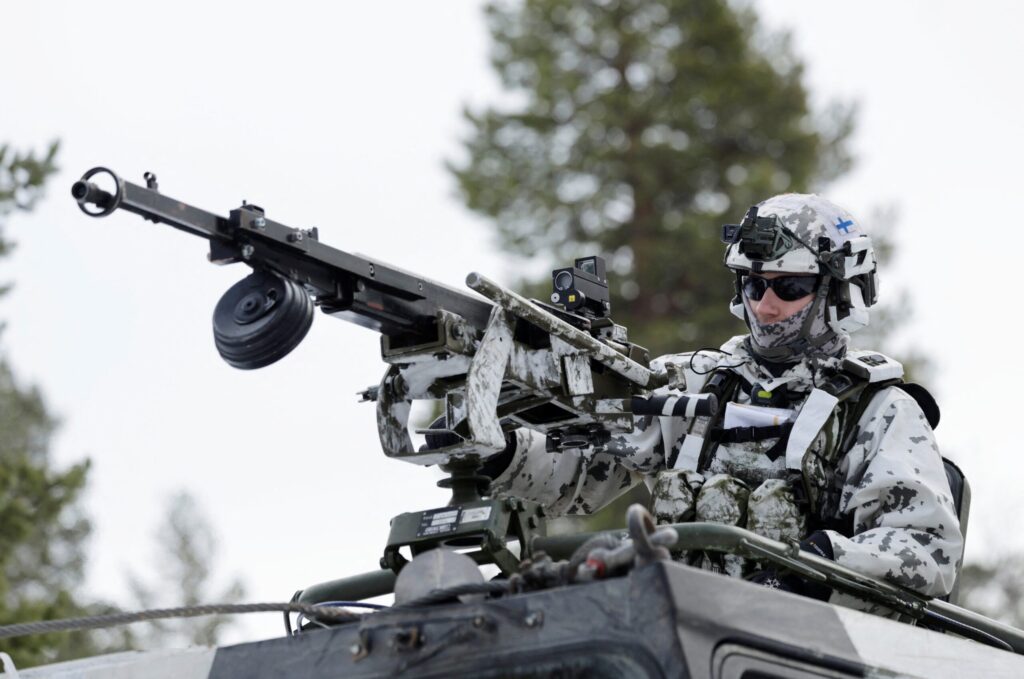

International work: Recommendations for the AANSRI
1. Assess gaps in multilateral resilience frameworks and develop options.
- Resilience methods might want to combine each alliance-based and bilateral mechanisms to make sure that safety cooperation stays adaptable, efficient, and aligned with nationwide pursuits.
- Analyze present multilateral resilience efforts (e.g., the UN, Organisation for Co-operation and Development, NATO, the G7, or the D10 initiative) to determine the place coordination, coverage frameworks, or operational capability are missing.
- Develop suggestions for a way present alliances and establishments might be tailored to incorporate sensible resilience-building packages, lowering the necessity for completely new buildings.
- Understand if multilateral establishments really adapt to the rising pace and complexity, or if there may be another mechanism that would work.
- Contextualize previous multilateral resilience responses, determine the structural limitations slowing resilience coordination, and spotlight such areas for reform.
2. Explore methods to streamline decision-making and combine sooner, extra versatile collaboration fashions, together with whether or not extra versatile coalitions might be managed beneath a brand new agile mechanism (a Democratic Resilience Alliance) pushed by the United States.
- Define targets, mode of operation, potential advantages past separate bilateral strands.
- Assess how such an alliance would differ from present boards (e.g., private-sector involvement as a essential companion).
- Investigate potential mechanisms for joint disaster response, knowledge sharing, and coverage alignment.
3. Develop a prioritized world resilience agenda for democracies.
- Identify key resilience priorities (e.g., provide chain safety, cyber protection, infrastructure safety, and countering financial coercion) and analyze the place bilateral agreements can ship sooner, extra focused outcomes.
- Assess how governments, multilateral establishments, and the non-public sector can collaborate on these priorities in new methods and outdoors of gradual bureaucratic techniques.
- Elevate cross-cutting points, reminiscent of press freedom, by public convenings that increase consciousness and construct help for resilience as a cornerstone of US worldwide management. The AANSRI is already advancing such efforts by its Reporters at Risk occasion collection.
- Investigate how private-sector actors reminiscent of insurers, expertise corporations, and logistics suppliers may be built-in into nationwide and worldwide resilience methods.
4. Strengthen world risk-sharing and crisis-response mechanisms.
- Explore risk-sharing agreements amongst likeminded nations, making certain that essential provides and disaster-response capabilities may be deployed effectively throughout borders.
- Assess the feasibility of joint stockpiles for essential assets (reminiscent of medical provides and pandemic-response supplies), strategic power reserves for democratic states, and cybersecurity response groups and shared intelligence operations.
- Examine fashions for multinational rapid-deployment crisis-response items, making certain that democracies can help one another shortly in cyber, local weather, or provide chain disruptions.
5. Learn from world exemplars in resilience.
- Identify nations or areas which have pioneered progressive resilience methods, analyzing greatest practices reminiscent of Taiwan’s advances in resilience in response to persistent and broad Chinese aggression, Japan’s earthquake preparedness and response framework, the Netherlands’ flood-resilience and water-management methods, Singapore’s strategy to meals safety and concrete resilience, and the Scandinavian fashions of power resilience and disaster preparedness.
- Assess how these fashions may be tailored for broader resilience methods, making certain that classes from nationwide resilience pioneers are shared amongst governments and worldwide organizations.
- Explore how cities may be working collaboratively on resilience at a sub-national degree.
6. Advance data-driven resilience methods at a world degree.
- Investigate the feasibility of a world resilience data-sharing framework, making certain that governments and establishments have entry to real-time danger intelligence.
- Develop predictive analytics fashions for resilience evaluation, utilizing AI and massive knowledge to trace rising dangers throughout US allies and companions.
- Assess how governments can combine resilience-focused AI instruments into nationwide and world crisis-management methods, making certain that AI-driven insights improve, reasonably than complicate, resilience efforts.
- Back to high
Conclusion
This report argues that resilience should be handled as a core pillar of nationwide and worldwide safety alongside protection, diplomacy, and financial energy. Democratic societies are already beneath sustained nationwide safety stress. These challenges are usually not distant and hypothetical, they’re already affecting our day by day lives. The quantity, complexity, and variety of danger is rising, and the potential for interconnected, concurrent and cascading shocks has elevated. Resilience is now a strategic necessity and a proactive nationwide asset.
Countries on the entrance line like as Ukraine, Taiwan, and Finland display how sustained management, public engagement, and long-term funding in resilience can considerably strengthen a nation’s capability to endure disruption. Their fashions are usually not straight transferable; every is rooted in distinct histories, geographies, and political cultures, however they provide precious insights for different democracies. There is far to study by mutual alternate: not nearly establishments and techniques, however about how societies put together their folks for uncertainty and reply when disruption escalates into full-blown disaster. There is a window of alternative for the US and allies to consciously spend money on constructing ‘resilience power’ in anticipation of mounting dangers. There continues to be time to form the long run extra proactively reasonably than be compelled to react to shocks from a place of weak spot.
Much has already been accomplished to strengthen resilience throughout allied nations, from new legislative frameworks and emergency protocols to expanded public consciousness and civic engagement. But there may be extra to do. That begins with recognizing that resilience is constructed from the bottom up, anchored within the energy of people whose psychological, social, and financial well-being kinds the bedrock of nationwide functionality. It would require diligence, nationwide management, and a long-term dedication.
The Adrienne Arsht National Security Resilience Initiative will focus its subsequent section of labor on 4 priorities: advancing analysis into particular person and neighborhood resilience; exploring alternatives to embed resilience in coverage and planning throughout sectors; convening leaders and equipping them with sensible instruments for resilient governance; and amplifying public understanding of resilience as a strategic crucial.
The safety of the United States and the free world will more and more rely not solely on our skill to discourage threats and challenge energy externally, however on our ‘resilience power’; our capability to face up to disruption, adapt beneath stress, and bounce ahead stronger.
Back to high
Task drive members
Elliot Ackerman
Author and former particular operations workforce chief, US Marine Corps
Adrienne Arsht
Executive vice chair and founder, Adrienne Arsht National Security Resilience Initiative, Atlantic Council
Nabeela Barbari
Business space vice chairman, Intelligence & Homeland Security Division,
General Dynamics;
former director, Resilience & Response, National Security Council,
White House
Norman Beauchamp
Executive vice chairman for well being sciences, Georgetown University Medical Center; govt dean,
Georgetown University School of Medicine
Jeanne Benincasa Thorpe
Former nationwide safety and resiliency director, Nixon Peabody LLP
Jenna Ben-Yehuda
Executive vice chairman, Atlantic Council
John Burnham
Lead of intel technique and mission command integration, Accenture Federal Services; former deputy assistant secretary of protection for menace discount and arms management,
US Department of Defense
Chris Donnelly
Principal counsellor, Earendel Associates
Stephen Flynn
Founding director, Global Resilience Institute, Northeastern University
Markus Garlauskas
Director, Indo-Pacific Security Initiative, Scowcroft Center for Strategy and Security, Atlantic Council
Tressa Guenov
Director, Operations and Programs, and senior fellow, Scowcroft Center for Security,
Atlantic Council
Alice Hill
David M. Rubenstein senior fellow for power and the atmosphere,
Council on Foreign Relations;
Former NSC senior director for resilience coverage,
White House
Jane Holl Lute
President and chief govt officer,
SICPA North America; former deputy secretary of homeland safety,
US Department of Homeland Security
James Johnson
Former director, Integrated Resilience Office, US Air Force,
US Department of Defense
Jocelyn Kelly
Director, Gender, Rights and Resilience (GR2) program, Harvard Humanitarian Initiative, Harvard University
Marta Kepe
Senior protection analyst, RAND Corporation
Frank Kramer
Former assistant secretary of protection for worldwide safety affairs,
US Department of Defense;
Distinguished Fellow, Atlantic Council
Matthew Kroenig
Vice president and senior director, Scowcroft Center for Strategy and Security, Atlantic Council
Alexis Long
Chair, British Transport Police Innovation Board; Former director of safety and technique,
London Heathrow Airport; Former chief innovation officer, Transportation Security Administration,
US Department of Homeland Security
Joel Meyer
President of public sector, Domino Data Lab; Nonresident senior fellow, GeoStrategy Initiative, Atlantic Council
Andrew Michta
Senior fellow, GeoStrategy Initiative, Scowcroft Center for Strategy and Security, Atlantic Council
Veera Parko
Ministerial advisor and strategic lead, Resilience/Preparedness, Ministry of the Interior, Finland
Ian Paterson
Chief govt officer, Plurilock Security
Tomáš Petříček
Former minister of international affairs, Czech Republic
Karen Schaefer
President,
KMS Consulting;
former chief of operations, Directorate of Science and Technology, Central Intelligence Agency
Stephen Shapiro
Senior advisor, Scowcroft Center for Strategy and Security,
Atlantic Council
Elizabeth Sizeland
Executive director, Adrienne Arsht National Security Resilience Initiative Task Force, Atlantic Council;
Former deputy nationwide safety adviser for safety, intelligence, and resilience,
United Kingdom
Caitlin Thompson
Principal, Caitlin Thompson Consulting LLC; former vice chairman,
Red Duke Strategies; former govt director, Office of Suicide Prevention,
US Department of Veterans Affairs
Samantha Vinograd
Nonresident senior fellow, Adrienne Arsht National Security Resilience Initiative,
Atlantic Council;
National Security Contributor,
CBS News;
Former Assistant Secretary for Counterterrorism and Threat Prevention,
US Department of Homeland Security
Tom Warrick
Nonresident senior fellow, Scowcroft Center for Strategy and Security, Atlantic Council;
former deputy assistant secretary for counterterrorism coverage, US Department of Homeland Security
Kayla Williams
Senior coverage researcher, RAND;
former assistant secretary of public and intergovernmental affairs, US Department of Veterans Affairs
Back to high
Glossary
Adaptability: The high quality of having the ability to alter to new, generally adversarial, situations with agility.
Adversarial powers: Nation-state actors that search to undermine democracy, freedom, and free-market liberalism (reminiscent of Russia, China, Iran, and North Korea).
Community bonds: The components that foster robust, related communities. This social cohesion influences readiness for crises dictates how networks mobilize when disasters strike and explains how social ties help rebuilding efforts and scale back long-term vulnerabilities.
Critical infrastructure: Vital sectors for the day-to-day functioning of a society, reminiscent of power, telecommunications, water techniques, transportation, healthcare, area techniques, and data expertise infrastructure. Threats to those techniques from adversaries would disrupt fundamental functioning and erode public belief.
Resilience energy: Internal cohesion in a society, constructed on mutual belief, that permits a society to work in lockstep within the face of inside or exterior threats. Resilience energy is a key pillar of nationwide safety.
Enabler (of resilience): A key attribute or situation that permits or facilitates resiliance for a person, society, or system.
External circumstances: Conditions which are exterior of a person’s management (e.g., early childhood experiences, schooling, neighborhood ties, and publicity to adversity) that affect their skill to reply to shocks.
Fragmentation: Limited coordination, particularly between state and native establishments and nationwide governments, that creates misaligned priorities throughout disaster response. This lack of unity could make it more durable to anticipate, stop, and reply successfully to crises.
Resilience: The skill of people, societies, and techniques to anticipate, stand up to, get better from, adapt to, and bounce ahead from shocks and disruptions.
Risk: A possible state of affairs that exposes an individual or society to hazard. Calculating the extent of danger includes assessing the mixture of the probability of this case coming about (e.g., the extent of vulnerability, any malevolent intent, and predictive knowledge) along with the extent of affect it might have (e.g., on private well being, financial stability, well-being, and safety).
Sovereignty: A authorities’s skill to rule itself.
Back to high
View the complete report
About the writer


Related content material


Report
Jul 2, 2024
Strengthening Taiwan’s resiliency
By
Franklin D. Kramer, Philip W. Yu, Joseph Webster, Elizabeth Sizeland
Resilience is a nation’s skill to grasp, tackle, reply to, and get better from any kind of nationwide safety danger. Given the dimensions of danger Taiwan faces from mainland China, home resilience needs to be entrance and middle in Taiwan’s nationwide safety technique, encompassing areas reminiscent of cybersecurity, power safety, and protection resilience.
Explore the packages


Image: 250207-N-GC571-1203 CELEBES SEA (Feb. 7, 2025) Sailors assigned to the Nimitz-class plane service USS Carl Vinson (CVN 70) conduct search and rescue coaching with an MH-60S Seahawk assigned to the “Black Knights” of Helicopter Sea Combat Squadron (HSC) 4 Feb. 7, 2025. Vinson, the flagship of Carrier Strike Group ONE, is underway conducting routine operations within the U.S. seventh Fleet space of operations. (U.S. Navy photograph by Mass Communication Specialist Seaman Apprentice Pablo Chavez)
You Might Also Like
Explore important updates within the Crypto area. This article explores: “For the US and the free world, security demands a resilience-first approach”.
- Blockchain & Crypto Trends — keep forward with world adoption, tech shifts & improvements
- DeFi & Web3 Innovations — discover the way forward for finance and web decentralization
- NFT, Gaming & Metaverse — dive into digital economies and digital asset revolutions
- AI & Blockchain Integration — uncover how AI enhances trustless blockchain ecosystems
- Regulations & Global Tech — comply with legal guidelines, compliance, and world tech coverage impacts
- Tokenomics & Coin Analysis — decode challenge worth, utility, and investor metrics
- Security & Blockchain Hacks — defend your crypto with menace and exploit insights
- Mining & Validator Ecosystem — study staking, block rewards, and consensus
Connected Crypto Coverage
- Explore BlockTrend for professional takes on blockchain developments & developments
- Visit CryptoCoil for reside market knowledge, altcoin insights & sentiment monitoring
- Check i-News for recent world crypto headlines & breaking tales
- Claim & earn with trusted drops on i-Coin — your faucet & incomes hub
- Learn crypto the good means on i-VIP — sensible tutorials, guides & ideas for novices
- Discover curated crypto insights on SFBNEWS — automated crypto updates & professional curation
[ad_3]
Original Source
This article is tailored from www.atlanticcouncil.org. We’ve restructured and rewritten the content material for a broader viewers with improved readability and web optimization formatting.
Your Crypto Source
Check out BLOCKTREND for trending blockchain information & tutorials.


![[Blockchain & Crypto Trends]](https://blocktrend.online/wp-content/uploads/2025/08/XRP-Emergency-Price-Break-Bitcoin-BTC-Losing-100000-If-This-400x240.jpg)

![[Blockchain & Crypto Trends]](https://blocktrend.online/wp-content/uploads/2025/08/XRP-Emergency-Price-Break-Bitcoin-BTC-Losing-100000-If-This-80x80.jpg)
![[Blockchain & Crypto Trends]](https://blocktrend.online/wp-content/uploads/2025/08/Trump-Media-Partners-With-Cryptocom-Launches-US1B-CRO-Strategy-Vehicle-400x240.jpg)
![[Blockchain & Crypto Trends]](https://blocktrend.online/wp-content/uploads/2025/08/Trump-Media-Partners-With-Cryptocom-Launches-US1B-CRO-Strategy-Vehicle-80x80.jpg)

![[Blockchain & Crypto Trends]](https://blocktrend.online/wp-content/uploads/2025/08/Bitcoin-miner-Hut-8-announces-15GW-expansion-in-the-US.jpg)

![[Blockchain & Crypto Trends]](https://blocktrend.online/wp-content/uploads/2025/08/REX-Financial-CEO-Solana-Not-Ethereum-Is-the-Future-of.webp-400x240.webp)
![[Blockchain & Crypto Trends]](https://blocktrend.online/wp-content/uploads/2025/08/REX-Financial-CEO-Solana-Not-Ethereum-Is-the-Future-of.webp-80x80.webp)

![[Blockchain & Crypto Trends]](https://blocktrend.online/wp-content/uploads/2025/08/CZ-Says-I-Advise-Twelve-Governments-and-Leaders-on-Crypto.png)

![[Security & Blockchain Hacks]](https://blocktrend.online/wp-content/uploads/2025/08/A-new-security-flaw-in-TheTruthSpy-phone-spyware-is-putting-400x240.jpg)
![[Security & Blockchain Hacks]](https://blocktrend.online/wp-content/uploads/2025/08/A-new-security-flaw-in-TheTruthSpy-phone-spyware-is-putting-80x80.jpg)
![[NFT, Gaming & Metaverses]](https://blocktrend.online/wp-content/uploads/2025/08/Ethereum-is-very-much-%E2%80%98the-Wall-Street-token-VanEck-CEO-400x240.jpeg)
![[NFT, Gaming & Metaverses]](https://blocktrend.online/wp-content/uploads/2025/08/Ethereum-is-very-much-%E2%80%98the-Wall-Street-token-VanEck-CEO-80x80.jpeg)

![[Security & Blockchain Hacks]](https://blocktrend.online/wp-content/uploads/2025/08/Criminals-are-%E2%80%98vibe-hacking-with-AI-at-unprecedented-levels-Anthropic.png)

![[AI & Blockchain Integration]](https://blocktrend.online/wp-content/uploads/2025/08/Nvidia-reports-record-sales-as-the-AI-boom-continues-400x240.jpg)
![[AI & Blockchain Integration]](https://blocktrend.online/wp-content/uploads/2025/08/Nvidia-reports-record-sales-as-the-AI-boom-continues-80x80.jpg)
![[DeFi & Web3 Innovations]](https://blocktrend.online/wp-content/uploads/2025/08/Alchemy-Pay-plugs-fiat-ramp-into-Boyaas-Web3-poker-game.w-400x240.webp)
![[DeFi & Web3 Innovations]](https://blocktrend.online/wp-content/uploads/2025/08/Alchemy-Pay-plugs-fiat-ramp-into-Boyaas-Web3-poker-game.w-80x80.webp)

![[Mining & Validator Ecosystem]](https://blocktrend.online/wp-content/uploads/2025/08/REX-Osprey-files-for-BNB-staking-ETF-as-monthly-inflows-pick.png)

![[Tokenomics & Coin Analysis]](https://blocktrend.online/wp-content/uploads/2025/08/Investors-Flock-To-XYZVerse-XYZ-For-Promising-Potential-While-ONDO-400x240.jpg)
![[Tokenomics & Coin Analysis]](https://blocktrend.online/wp-content/uploads/2025/08/Investors-Flock-To-XYZVerse-XYZ-For-Promising-Potential-While-ONDO-80x80.jpg)

![[Tokenomics & Coin Analysis]](https://blocktrend.online/wp-content/uploads/2025/08/Pi-Coins-Charts-Hint-at-a-Turnaround%E2%80%94Heres-Why-a-40.png)

![[Security & Blockchain Hacks]](https://blocktrend.online/wp-content/uploads/2025/08/Anthropic-Cybersecurity-Team-Warns-%E2%80%98Agentic-AI-Has-Been-Weaponized.png)

![[AI & Blockchain Integration]](https://blocktrend.online/wp-content/uploads/2025/08/Swarm-Network-raises-13M-to-facilitate-decentralized-AI-400x240.jpeg)
![[AI & Blockchain Integration]](https://blocktrend.online/wp-content/uploads/2025/08/Swarm-Network-raises-13M-to-facilitate-decentralized-AI-80x80.jpeg)